
Last updated September 22, 2026
Free on-site gate assessment - hinges, posts, and your LiftMaster or Nice gate operator checked before anything is quoted
The assessment is free and the quote is the invoice.

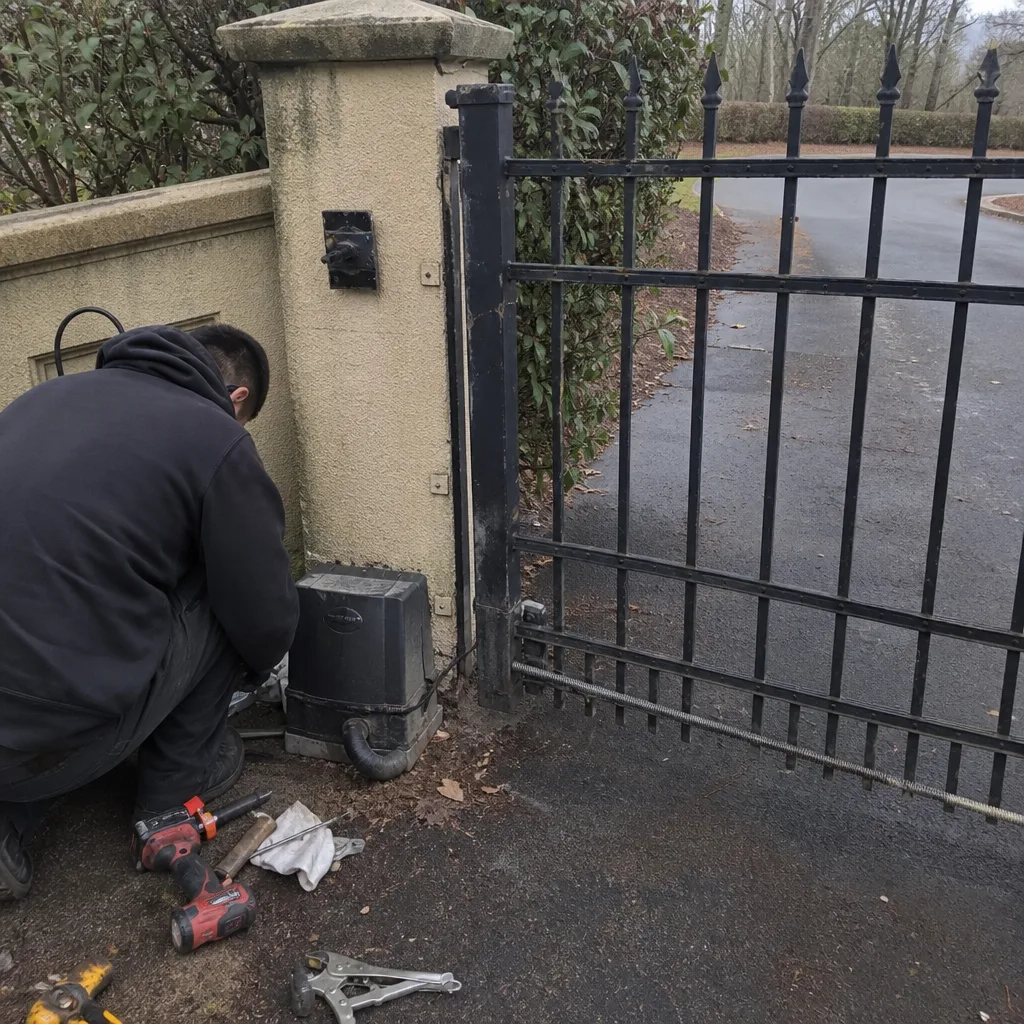 Before
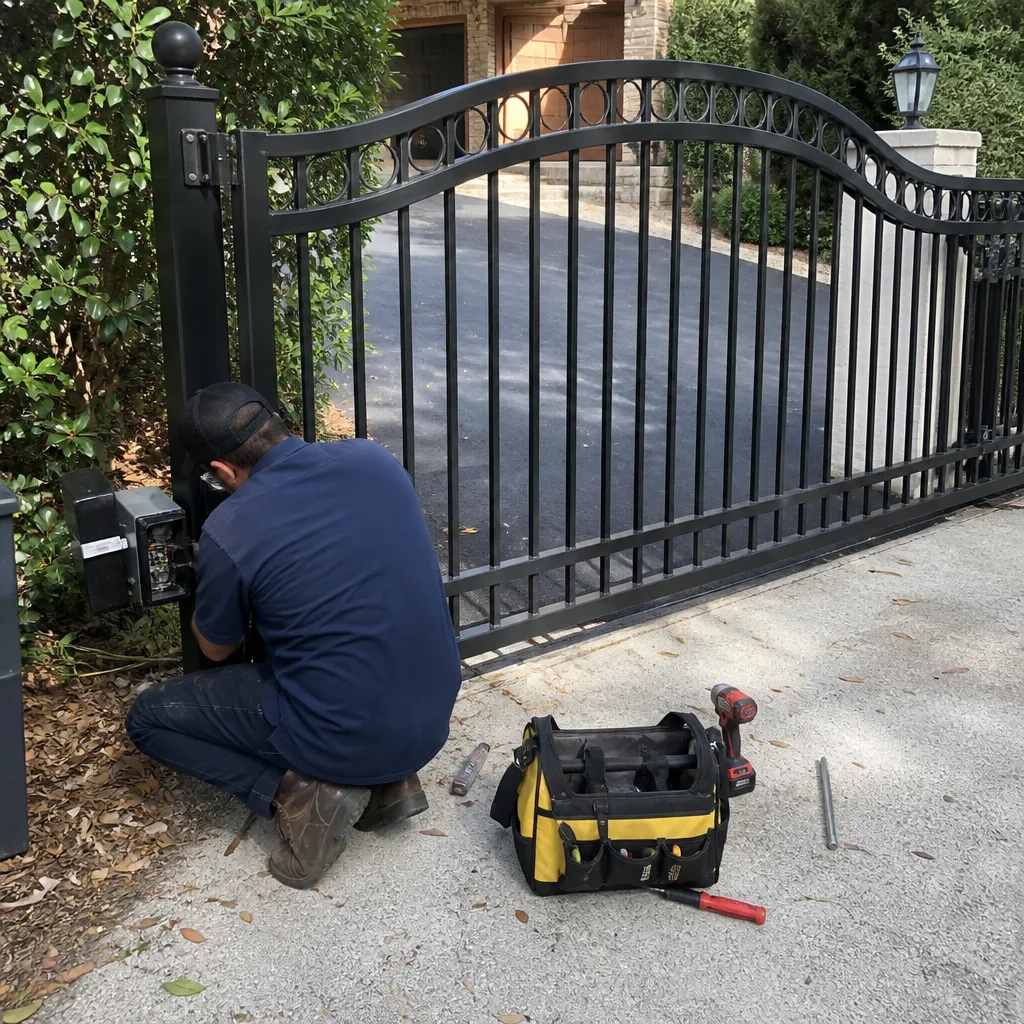 After
After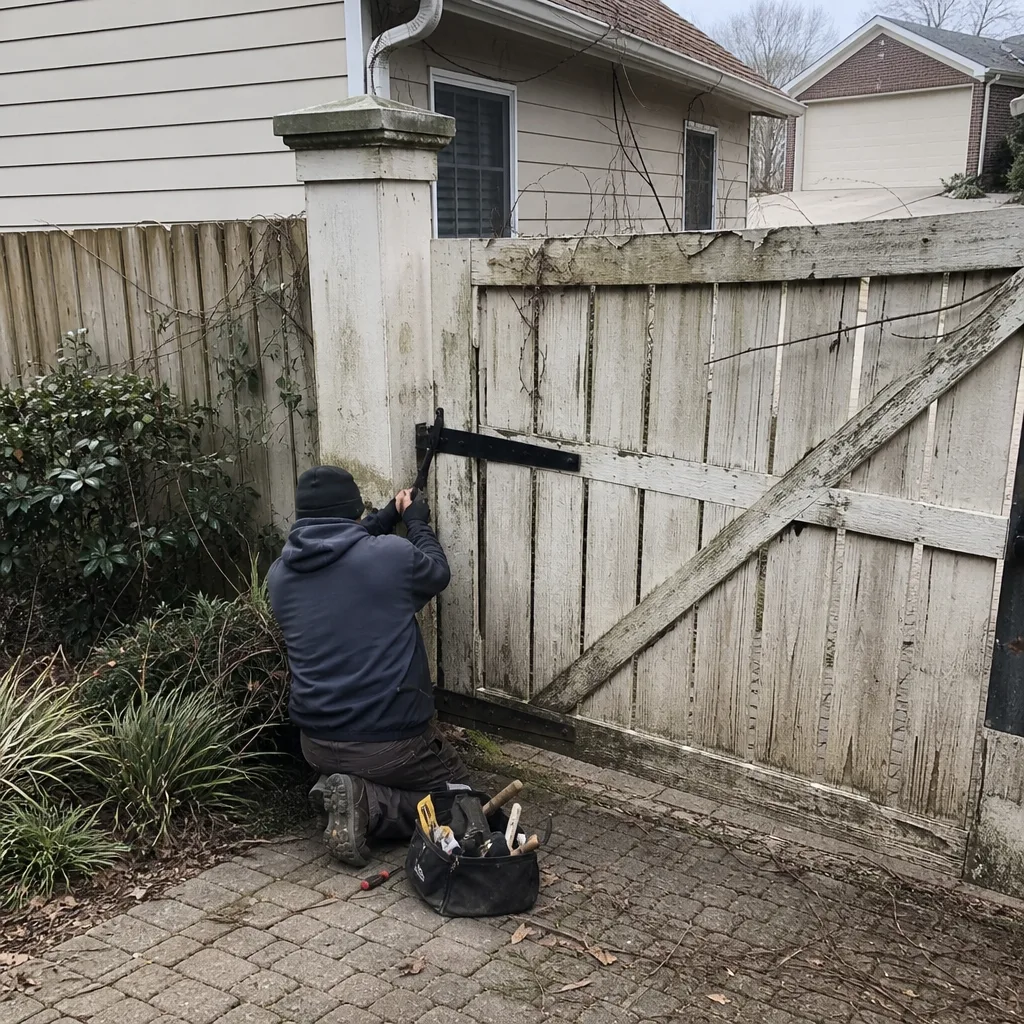 Before
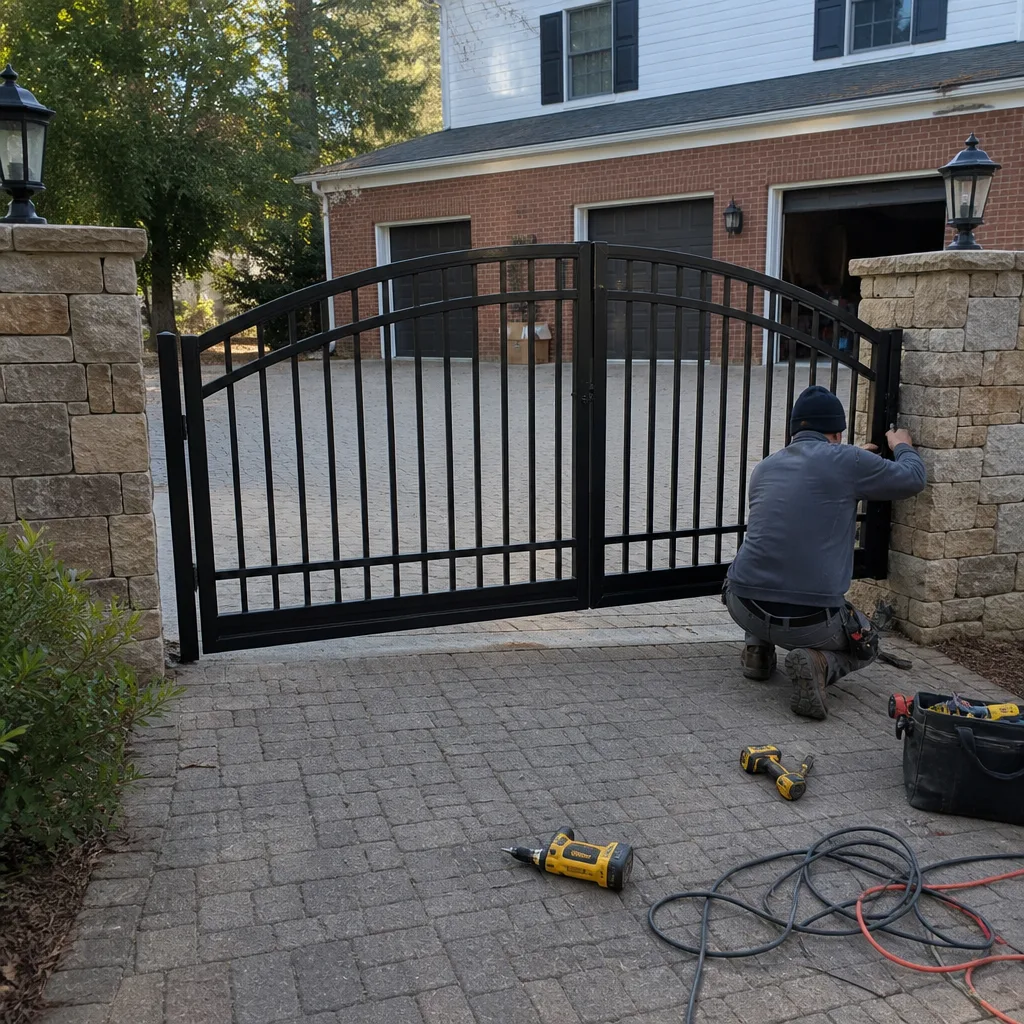 After
After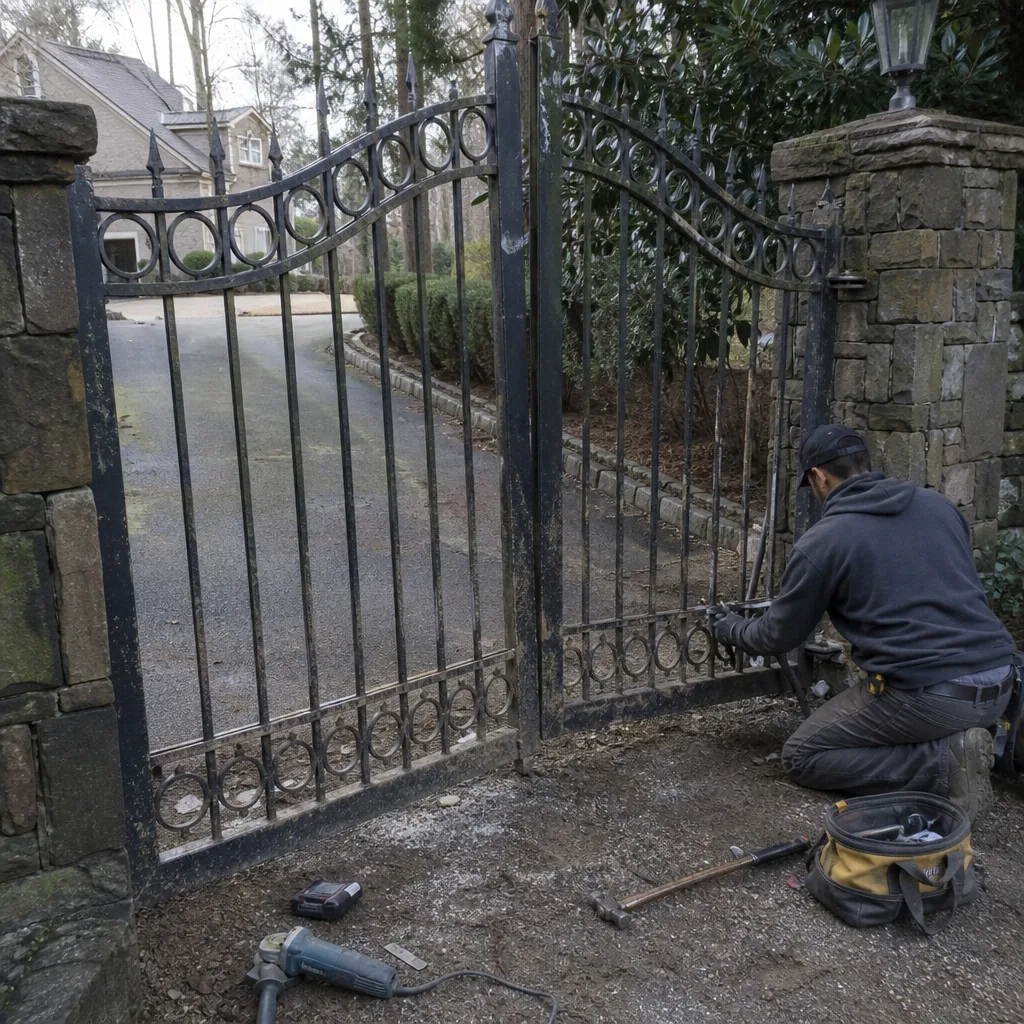 Before
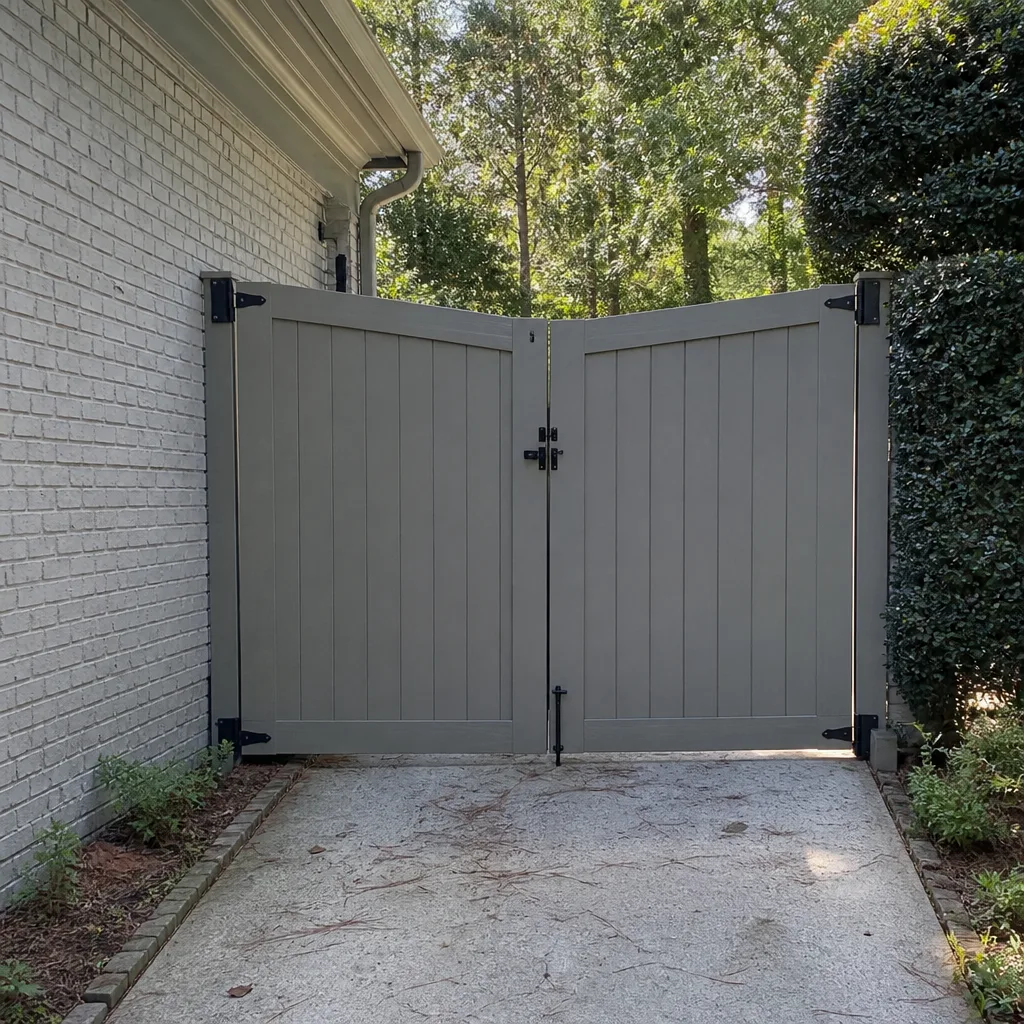 After
AfterGate Repair Maintenance Checklist for Johns Creek Homeowners
Most gate maintenance checklists tell you to “lubricate the chain” without specifying what lubricant, what quantity, or what condition means the chain is already past lubrication and needs replacement. After servicing thousands of gates across north metro Atlanta, we’ve found that a checklist without pass/fail thresholds is just a feel-good exercise. It doesn’t produce a record you can hand to your insurance company after a gate strike, and it won’t catch the five maintenance skips that turn a $120 adjustment into a $600 component replacement. This guide gives Johns Creek homeowners exact measurements, torque checkpoints, and a photo-documentation protocol that creates a usable condition record, not vague reassurance.
Quick Answer
A proper gate maintenance checklist for Johns Creek homeowners includes monthly visual inspections, quarterly mechanical checks with measurable tolerances, and annual electrical and safety-system verification. Each check should produce dated photos and written readings (gap measurements, voltage levels, torque values) that create a baseline for comparison. Without these specifics, maintenance is just guesswork that leaves you exposed when a component fails.
Table of Contents
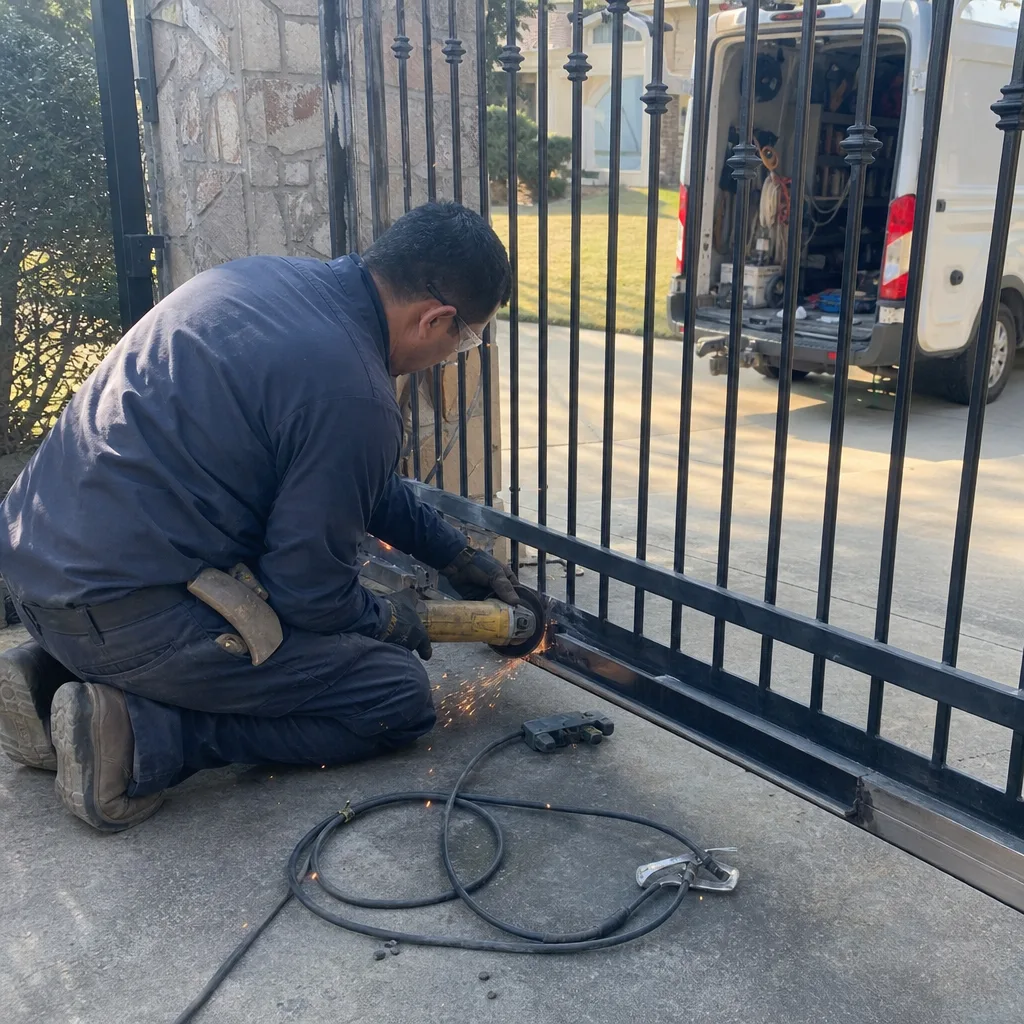
- Monthly Visual Inspection: What to Look For
- Quarterly Mechanical Checks with Pass/Fail Thresholds
- Annual Electrical and Safety System Verification
- Johns Creek-Specific Maintenance Concerns
- The Five Deferred Items That Escalate Fastest
- Photo-Documentation Protocol for Homeowners
- How to Log Checks for Warranty and Insurance
BeforeAfterMonthly Visual Inspection: What to Look For
We recommend a 10-minute walk-around on the first Saturday of each month. The goal isn’t to fix anything. It’s to spot changes from your established baseline before they become failures.
Start with the gate leaf or leaves themselves. For swing gates in Johns Creek, check the bottom edge clearance. A properly hung swing gate should maintain 1 to 2 inches of clearance above the driveway surface. Less than 1 inch means the hinge post is settling or the gate is sagging. More than 3 inches suggests hinge wear or post heave. Measure with a tape measure, not by eye. Write it down.
For sliding gates, inspect the track or cantilever rollers. The gate should travel without lateral wobble. A healthy V-groove roller on a cantilever system shows no more than 1/8 inch of side-to-side play when you push the gate manually. More play means the roller bearings are degrading. On ground-track systems, the gate should sit level on the track with no visible gap between the bottom guide bracket and the track surface.
Check all visible fasteners. We’re looking for:
- Zinc-plated or stainless hardware with no rust blooms
- No missing cotter pins or snap rings on hinge pins
- No cracked or UV-degraded wire insulation on low-voltage control cables
- No vegetation growth within 6 inches of any moving part or safety sensor
Test the manual release. Every gate operator has one, typically a key switch or lever. You should be able to disengage the motor and move the gate by hand with moderate effort. If the release is seized or the gate won’t budge when disengaged, that’s a failure. Don’t force it. Document it and call for service.
Listen during a full open-close cycle. Grinding from a swing-gate arm usually means the internal gearbox is dry or failing. A rhythmic clunk in a sliding gate often indicates a cracked drive belt or missing track clip. Squealing from a LiftMaster or Mighty Mule operator typically points to a dry chain or worn sprocket. Note the sound, note the date, take a 10-second video.
Quarterly Mechanical Checks with Pass/Fail Thresholds
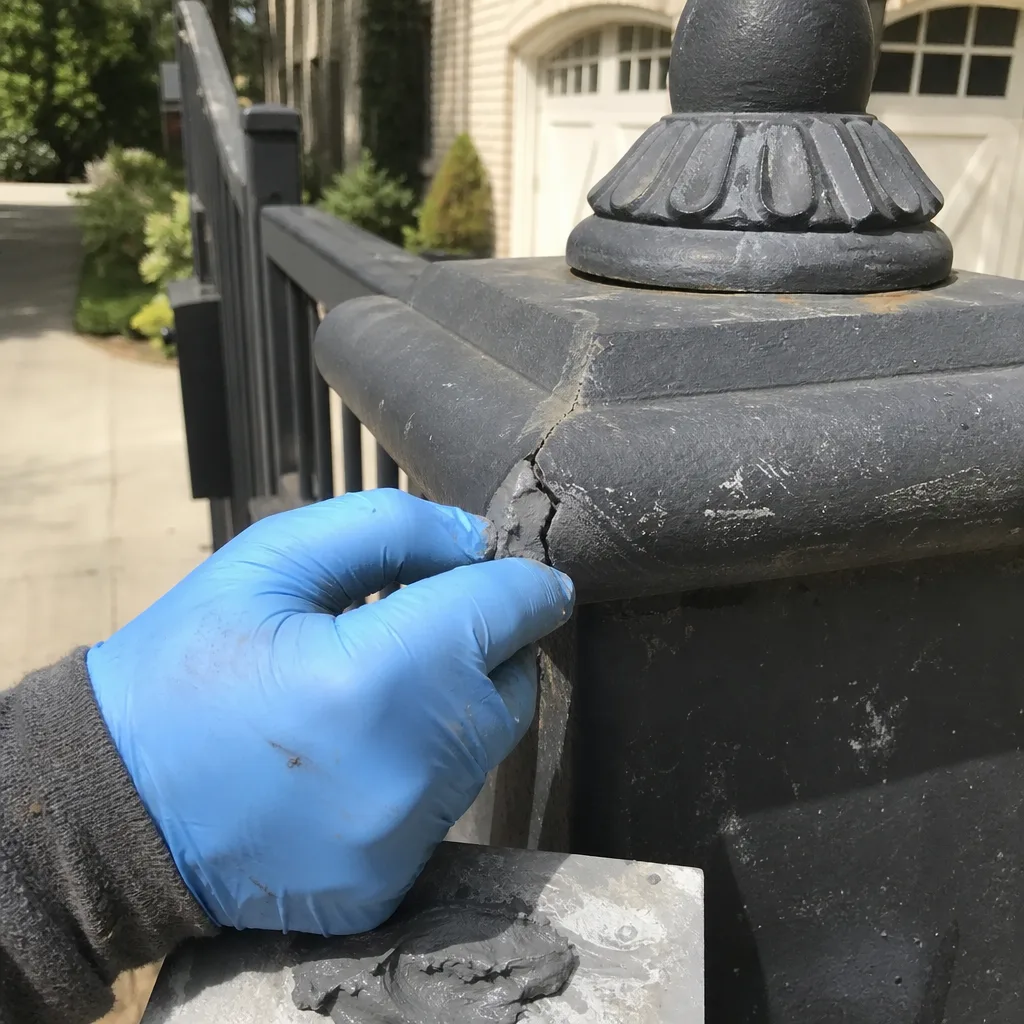
Every three months, set aside 45 minutes for hands-on checks with tools. These are the checks that separate a $120 adjustment from a $600 replacement.
Hinge Play Measurement
For swing gates, grasp the free end and push side-to-side. Measure the movement at the latch edge with a dial indicator or even a ruler held steady. Acceptable hinge play is 2 millimeters or less. Between 2 and 5 millimeters, the hinge pin or bushing is wearing and needs scheduled replacement. Over 5 millimeters, the gate is stressing the operator arm with every cycle, and you’re likely looking at premature gearbox failure.
To check: close the gate fully. Place a block of wood or a second person’s foot to hold the hinge post steady. Push the latch edge horizontally. The movement you measure is hinge play. Record it in millimeters.
Roller and Wheel Gap Tolerances
On cantilever sliding gates, the gate should float between the upper and lower roller assemblies with 1/4 to 3/8 inch of vertical clearance at each roller set. Less than 1/4 inch means the gate frame is riding the rollers, not rolling on them. More than 1/2 inch allows the gate to bounce and derail in wind or if the operator accelerates abruptly.
On V-track systems with wheel carriages, the wheels should sit fully in the track V with no visible daylight under the wheel tread. A 1/16-inch feeler gauge should not pass between wheel and track at any point.
Chain Tension and Condition
Chain-driven operators need 1/2 to 3/4 inch of vertical sag at the midpoint between sprockets. More sag causes chain slap and accelerated sprocket wear. Less tension overloads the gearbox bearings.
Chain condition is pass/fail. Look for:
- Rust that flakes when scraped with a fingernail - fail, replace
- Side plate spread where the pin heads no longer sit flush - fail, replace
- Pin rotation visible as a polished circle where the pin meets the plate - fail, replace
- Kinking or tight links that don’t flex smoothly by hand - fail, replace
If the chain passes visual inspection, lubricate with a dry chain lube (not WD-40, which attracts grit). Apply sparingly: a light film on the inner rollers, wiped excess. Over-lubrication in Johns Creek’s pollen season becomes a paste that accelerates wear.
Arm Bracket and Mounting Bolt Torque
Swing-gate operator arms attach to the gate via a bracket with typically two 1/2-inch or 5/8-inch bolts. These loosen over time from vibration. Check torque with a wrench: 45 ft-lbs for 1/2-inch grade 5 bolts, 75 ft-lbs for 5/8-inch. If a bolt turns before reaching spec, remove it, inspect for thread damage, and replace if the threads show distortion.
Never re-torque a bolt that has loosened significantly without investigating why. Repeated loosening usually means the bracket is flexing, the gate is overweight for the operator, or the mounting surface is deteriorating.
Annual Electrical and Safety System Verification
Once a year, preferably before winter, perform a full electrical and safety verification. This is the check that protects you from liability if the gate ever strikes a vehicle or person.
Battery Backup Voltage Test
Unplug the operator or flip the dedicated breaker. Attempt to cycle the gate. It should open and close at normal speed on battery power alone. After one full cycle, measure battery voltage at the operator terminals with a multimeter. A healthy 12V sealed lead-acid battery reads 12.6 to 12.8 volts at rest. Below 12.4 volts means the battery is degrading and won’t provide reliable backup during a Johns Creek ice-storm outage. Below 12.0 volts, replace immediately.
For lithium backup systems (increasingly common in newer FAAC and BFT operators), the acceptable range is typically 13.2 to 14.4 volts. Check your operator manual, but never assume a lithium battery is fine because it’s “newer technology.” We’ve replaced 18-month-old lithium packs that failed from heat exposure in enclosed aluminum housings.
Photo-Eye Alignment and Response
The photo-eye (the infrared beam that stops the gate if something crosses the path) must be aligned within 2 degrees. Most units have LED indicators: steady green or blue means aligned, flashing or red means misaligned. But LEDs can lie. Do the cardboard test: slide a piece of cardboard through the beam path during closing. The gate must reverse within 0.75 seconds. If it continues for even one more second, the photo-eye sensitivity is set too low or the receiver is failing.
Clean the lenses with a lint-free cloth. Pollen film in Johns Creek’s March-April peak can reduce effective range by 30 percent without triggering the LED.
Edge Sensor and Contact Strip Function
If your gate has safety edges (rubber contact strips on the leading edge), test by pressing the strip firmly with your palm during closing. The gate should reverse immediately. Test every 12 inches along the strip’s length. A dead zone of even 4 inches means the internal switch tape has a break. Replace the entire edge; patching doesn’t last.
Control Board Diagnostic Read
Modern operators from LiftMaster, DoorKing, and Viking store fault codes. Access the diagnostic menu per the manufacturer’s procedure (usually a button sequence on the control board). Record any stored codes, then clear them. Run five full cycles and recheck. New codes appearing indicate an active problem, not a historical one. Document the codes; they’re evidence if you later need warranty support.
Johns Creek-Specific Maintenance Concerns
Johns Creek sits at roughly 1,000 feet elevation with clay-heavy soils that expand and contract dramatically with moisture. This creates maintenance issues that coastal or sandy-soil regions simply don’t face.
Freeze-Thaw Post Heave Checks
After the first hard freeze each winter, check swing-gate posts for vertical movement. Drive a nail into the post at ground level in autumn. In spring, measure any exposed nail length above grade. More than 1/4 inch of heave means the post footing is inadequate or drainage is pooling at the base. Heave over 1/2 inch will eventually stress hinge welds and operator mounting brackets until they crack.
In neighborhoods like Country Club of the South and St. Ives, where irrigation systems run through winter, post heave is more common. The combination of saturated clay and freeze-thaw cycles pushes posts upward even with properly sized footings. If you notice heave, check that sprinkler heads aren’t directing water against the post base.
Pollen-Season Operator Enclosure Cleaning
Johns Creek’s pine and oak pollen season (typically late February through April) coats everything in yellow-green film. For operators with vented enclosures, this pollen accumulates on circuit boards and cooling fins. Once pollen meets humidity, it becomes conductive enough to cause erratic behavior or board failure.
Quarterly during pollen season, blow out the operator enclosure with compressed air. Hold the nozzle at least 6 inches from components to avoid damaging surface-mount parts. If your operator is a FAAC or BFT unit with a sealed enclosure, wipe the exterior vents only; don’t open the sealed housing.
Lightning and Surge Exposure
Johns Creek averages 50-60 thunderstorm days annually. Gate operators are vulnerable because their low-voltage wiring runs underground in conduit that can carry induced voltage from nearby strikes. Annual check: inspect the surge protector status LED if your operator has one. If the LED is off or red, the protector has sacrificed itself and needs replacement. No surge protector installed? That’s a significant gap in protection for this region.
HOA and Municipal Compliance
Many Johns Creek subdivisions, particularly in the Medlock Bridge and Abbotts Bridge corridors, have architectural review requirements for gate modifications. Before replacing an operator or changing gate style, verify whether your HOA requires pre-approval. The City of Johns Creek does not regulate residential gate maintenance directly, but Fulton County building codes apply to new installations and structural modifications. Keep your maintenance records; they demonstrate due diligence if a neighbor dispute or insurance claim arises.
The Five Deferred Items That Escalate Fastest
We’ve ranked these by how quickly a skipped check becomes a major repair, based on our field data from Johns Creek calls.
- Hinge bushing wear (2-4 months to failure). Once a hinge bushing exceeds 5mm play, the gate begins oscillating during operation. That oscillation transmits through the operator arm into the gearbox. We’ve replaced $800 FAAC gearboxes that failed because a $12 bushing was ignored for three months. Check quarterly, replace at 3mm.
- Chain dry-out on exposed operators (1-3 months to failure). A dry chain doesn’t just squeal. It galls the sprocket teeth, turning a $45 chain into a $280 chain-plus-sprocket job plus labor. In Johns Creek’s sun exposure, chains dry faster than in shaded or northern climates. Monthly visual check, quarterly lube.
- Photo-eye misalignment after ground settling (immediate safety risk). A misaligned photo-eye doesn’t protect anyone. If a gate strikes a visitor’s car, your maintenance log is the first thing your insurance adjuster requests. Monthly beam test, quarterly alignment verification.
- Battery backup below 12.4V (next outage is the failure). You won’t know the battery is dead until the power goes out and your gate won’t open for emergency vehicles or evacuation. Annual voltage test, replace proactively at 12.4V.
- Post heave over 1/2 inch (6-18 months to structural failure). Slowest to escalate, but most expensive. A heaved post eventually cracks the concrete footing, tears hinge welds, and may require full gate removal to re-pour. Annual measurement, intervene at 1/4 inch.
Photo-Documentation Protocol for Homeowners
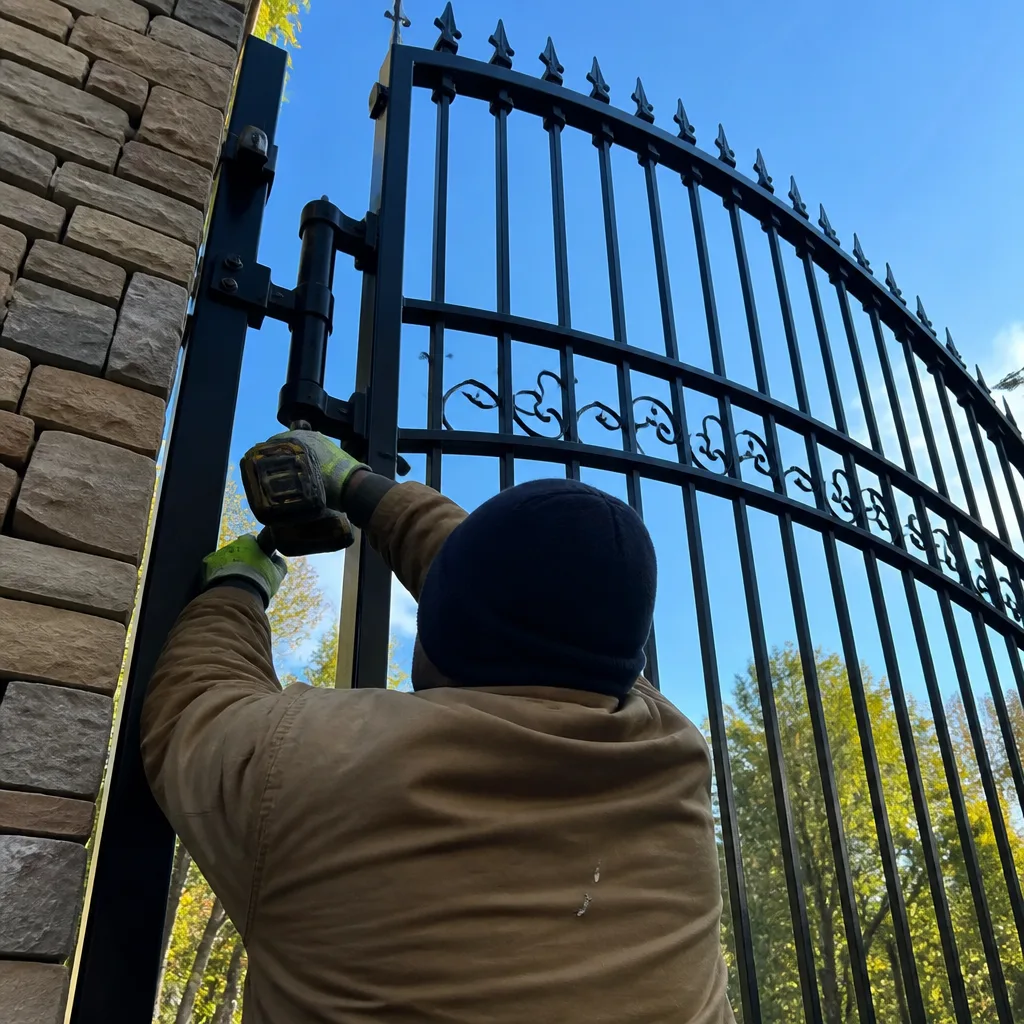
Under The Haven Standard, every Vance Gate Repair visit leaves a photographed record. You can apply the same discipline to your own maintenance checks. The goal is a dated, locatable image set that any future technician can interpret without guessing.
Required Photos Each Check
- Full gate, closed position. Stand at the property line, capture the entire gate and both posts. This shows sag, twist, and clearance in one frame.
- Hinge close-up. Flash on, focus on the pin and bushing interface. Any wear, rust, or grease condition is visible.
- Operator nameplate. Every operator has a model and serial number plate. Photograph it legibly. This eliminates parts-ordering errors when service is needed.
- Control board with diagnostic display visible. If your operator shows fault codes or cycle counts, photograph the display. Date-stamped evidence of normal readings helps distinguish pre-existing conditions from new failures.
- Safety sensor alignment LEDs. Photo-eyes usually show green/blue when aligned. Photograph the LED status during your monthly check.
- Any anomaly found. If you measure 6mm hinge play, photograph the dial indicator or ruler in position. If the chain has a tight link, photograph the kink with a finger pointing to it for scale.
Storage and Naming
Name files: YYYY-MM-DD_GateLocation_Component.jpg. Store in a cloud folder shared with your household. If you ever sell the property, hand over the folder. A documented maintenance history is a selling point in Johns Creek’s market.
For new gate installations in Johns Creek, we provide a baseline photo set before we leave. Homeowners who continue the practice tell us it takes 10 minutes per check and has saved them from at least one major repair by catching hinge wear early.
How to Log Checks for Warranty and Insurance
A photo without context is just a picture. A log entry without a photo is just a claim. Combine them properly, and you have defensible documentation.
Use this format for each quarterly check:
- Date: [YYYY-MM-DD]
- Inspector: [Name]
- Gate location: [Front driveway, rear service, etc.]
- Operator model: [From nameplate photo]
- Hinge play: [X mm, pass/fail]
- Chain condition: [Pass with lube / Replace / Replaced on date]
- Photo-eye response: [Reverse time in seconds, pass/fail]
- Battery voltage: [X.X volts, pass/fail]
- Anomalies found: [Description, photo filename reference]
- Actions taken: [Lubricated, adjusted, scheduled service, etc.]
Keep three years of records minimum. Georgia’s statute of limitations on property damage claims is four years, and insurance companies can request maintenance history to determine whether a gate failure was due to neglect (potentially denying coverage) or unforeseeable defect.
If your gate ever causes injury, this log becomes part of the incident investigation. A gap of 18 months with no entries suggests inadequate maintenance. Quarterly entries with pass/fail criteria demonstrate reasonable care.
Common Mistakes to Avoid
- Using WD-40 on chains. It’s a solvent and water displacer, not a lubricant. It strips existing grease and attracts abrasive pollen and dust. Use a dry chain lube or the manufacturer-specified product.
- Tightening a loose bolt without checking why it loosened. A bolt that backs out repeatedly is a symptom. The bracket may be flexing, the gate may be overweight for the hardware, or the threads may be damaged. Replace and investigate, don’t just re-torque.
- Ignoring the manual release test. We’ve arrived at Johns Creek homes where the release hasn’t been tested in years and is now seized by corrosion. During a power outage or emergency, that’s a trapped vehicle or a blocked fire access.
- Measuring by eye instead of with tools. “Looks fine” isn’t a measurement. Hinge play of 4mm and 6mm look identical to casual observation. The difference is one gets a bushing, the other gets a gearbox.
- Skipping checks in winter. Freeze-thaw damage happens between your quarterly checks if you skip the January-February window. The heave you catch in March may already have cracked a weld.
- Not photographing the operator nameplate. When you call for service and can’t provide the model number, we can’t bring the right parts. A 10-second photo eliminates a second trip charge.
- Assuming a new gate doesn’t need maintenance. Installation settling happens in the first 6-12 months. Post footings compact, fasteners loosen from initial vibration, and limit switches drift. The first annual check on a new gate is often the most important.
When to Call a Professional
Some conditions exceed homeowner maintenance and require trained diagnosis. Call for service if you find hinge play over 5mm, chain side-plate spread, battery voltage below 12.0V, any crack in a weld or gate frame, or if the gate reverses erratically without obstruction. Electrical diagnostics on 120V operator circuits should be left to licensed technicians. Gate operators store lethal voltage in capacitors even when unplugged.
Vance Gate Repair Johns Creek offers free estimates in Johns Creek. We’ll review your maintenance log, perform a full diagnostic with documented readings, and provide a written price before any work starts under Haven Standard Clause 1. Call (678) 394-1765 to schedule.
Frequently Asked Questions
Professional annual maintenance typically runs $180 to $320 for a single residential gate, depending on access, gate type, and whether the operator needs internal cleaning. This includes hinge play measurement, chain condition assessment, safety system verification, battery load test, and a documented photo record. Deferred maintenance that requires component replacement, such as a worn chain and sprocket set, adds $280 to $450. Call (678) 394-1765 for a written estimate on your specific gate.
Homeowners can safely perform monthly visual checks, photo-eye cleaning, and vegetation clearing. Quarterly mechanical checks with torque wrenches and multimeters require some mechanical comfort but are within reach of most homeowners who follow this guide. Annual electrical diagnostics, control board fault analysis, and any work inside the operator enclosure should be handled by a technician. The 120V supply and stored capacitor voltage in gate operators create genuine electrocution risk. Under Haven Standard Clause 4, our technicians provide a documented photo record of every adjustment so you have evidence of professional service for warranty and insurance purposes.
Quarterly during normal conditions, monthly during pollen season (March through May). Use a dry chain lube, not WD-40. Apply a light film to the inner rollers while rotating the chain slowly by hand. Wipe excess with a rag. In Johns Creek’s combination of pollen, humidity, and summer dust, over-lubrication creates abrasive paste that wears sprockets prematurely.
A complete gate installation in Johns Creek includes post excavation and concrete footing, gate fabrication or prefabricated gate hanging, operator mounting and programming, safety system installation (photo-eyes and edge sensors where required), control wiring in conduit, and final adjustment with documented limit-switch settings and cycle testing. Vance Gate Repair provides a written scope and written price before work begins, plus a photographed record of post depths, concrete pours, and operator settings on completion. Power run from the house to the operator location is quoted separately based on trenching distance and existing panel capacity.
Yes. We run 120V power in buried conduit from your existing panel or outdoor receptacle to the operator location, installed to NEC and local code. Safety edges are installed on all gates where the leading edge poses a strike hazard, programmed into the operator’s safety circuit, and tested for reverse response at every point along the edge length. Both are included in the written scope and price before work starts.
Replacement becomes the better option when the operator is over 12-15 years old, the manufacturer has discontinued parts, or repair costs exceed 60 percent of replacement cost. We service nine major brands including LiftMaster, Mighty Mule, and FAAC, so repair is often viable even on older units. Our diagnostic includes a written repair estimate and a replacement option with both prices, so you can compare. The 365-Day Done Right Promise applies to either choice.
The Bottom Line
A gate maintenance checklist works only when each item produces a measurement, not a mood. Hinge play in millimeters. Battery voltage to the tenth. Photo-eye response in seconds. Photos with dates and filenames. This is the record that protects your investment, supports your warranty claims, and demonstrates due diligence if an incident ever occurs. Johns Creek’s clay soils, freeze-thaw cycles, and pollen loads create specific maintenance demands that generic checklists miss. Apply the pass/fail thresholds in this guide quarterly, document everything, and you’ll catch the small problems before they become the expensive ones.
Written by Adrian Vance, Owner at Vance Gate Repair Johns Creek, serving Johns Creek since 2014.