
Last updated September 22, 2026
Free on-site gate assessment - hinges, posts, and your LiftMaster or Nice gate operator checked before anything is quoted
The assessment is free and the quote is the invoice.

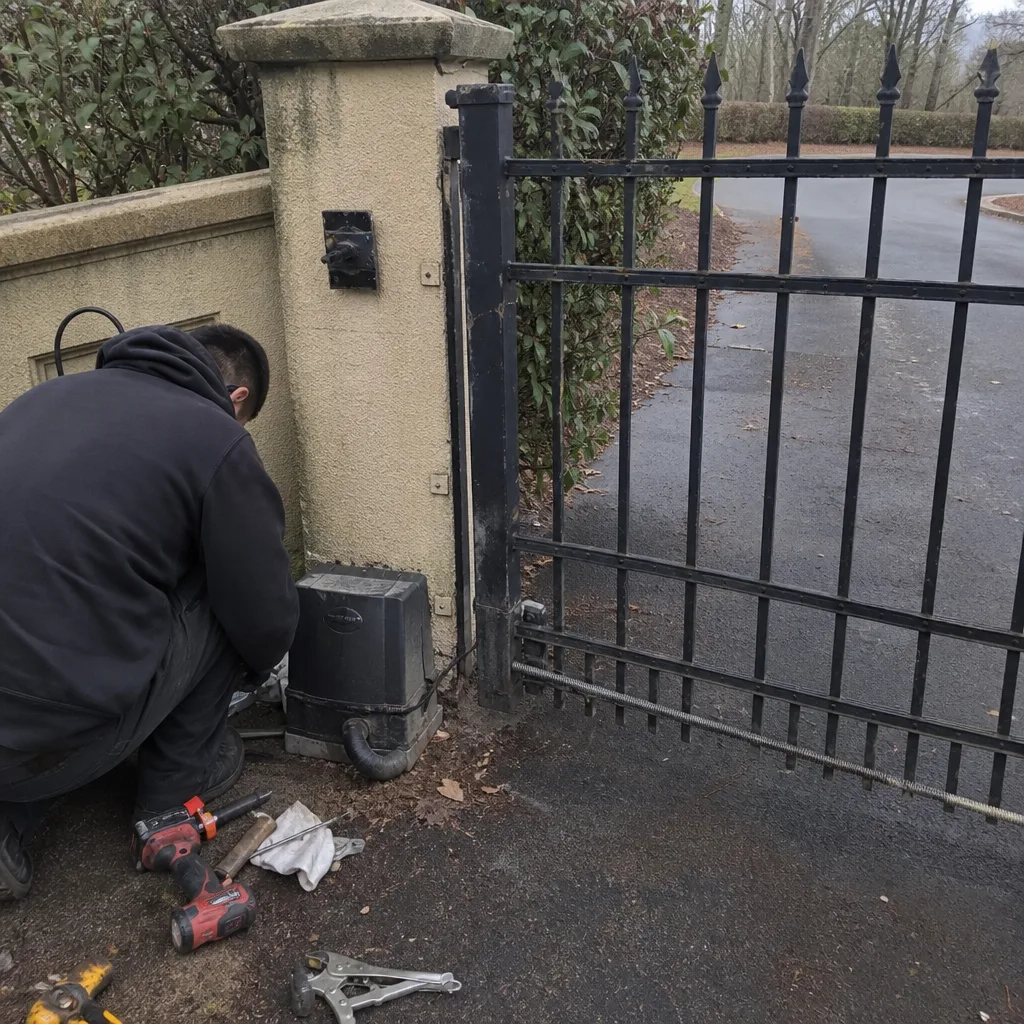 Before
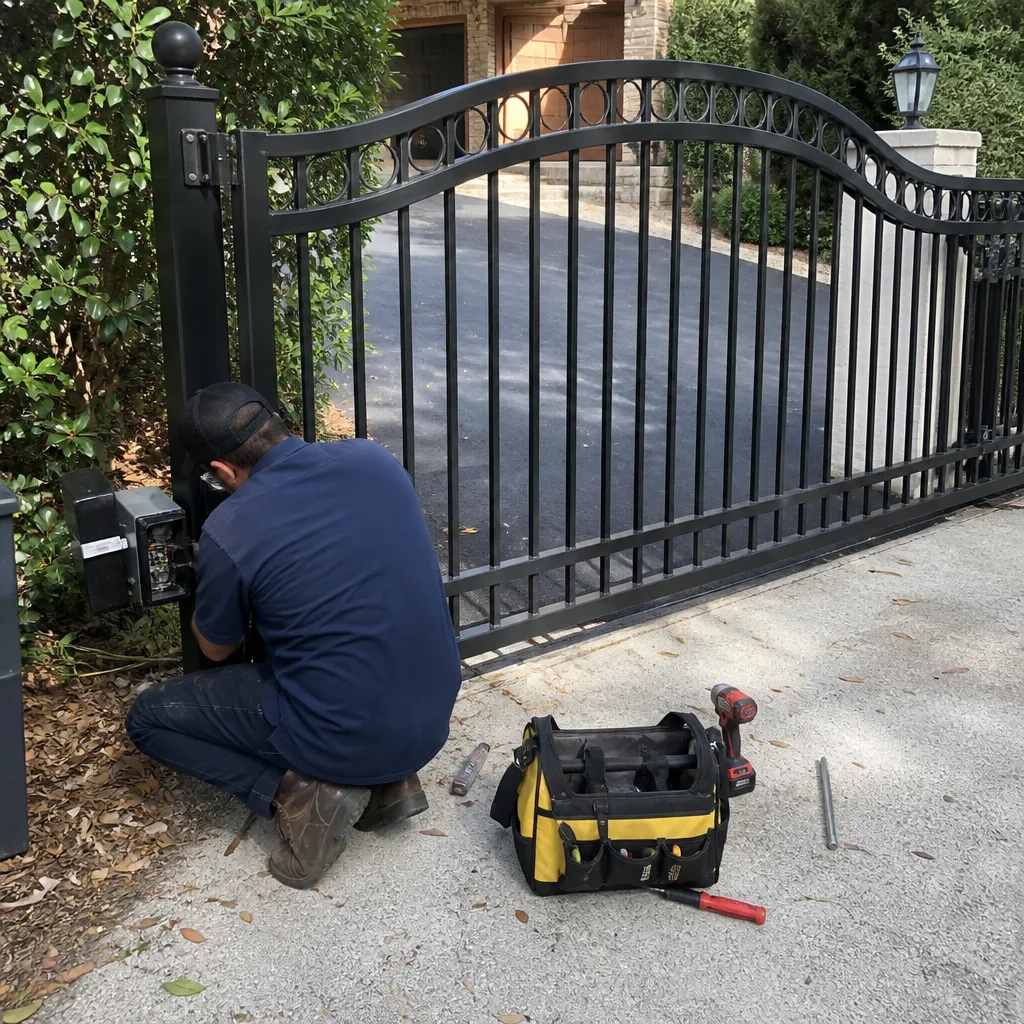 After
After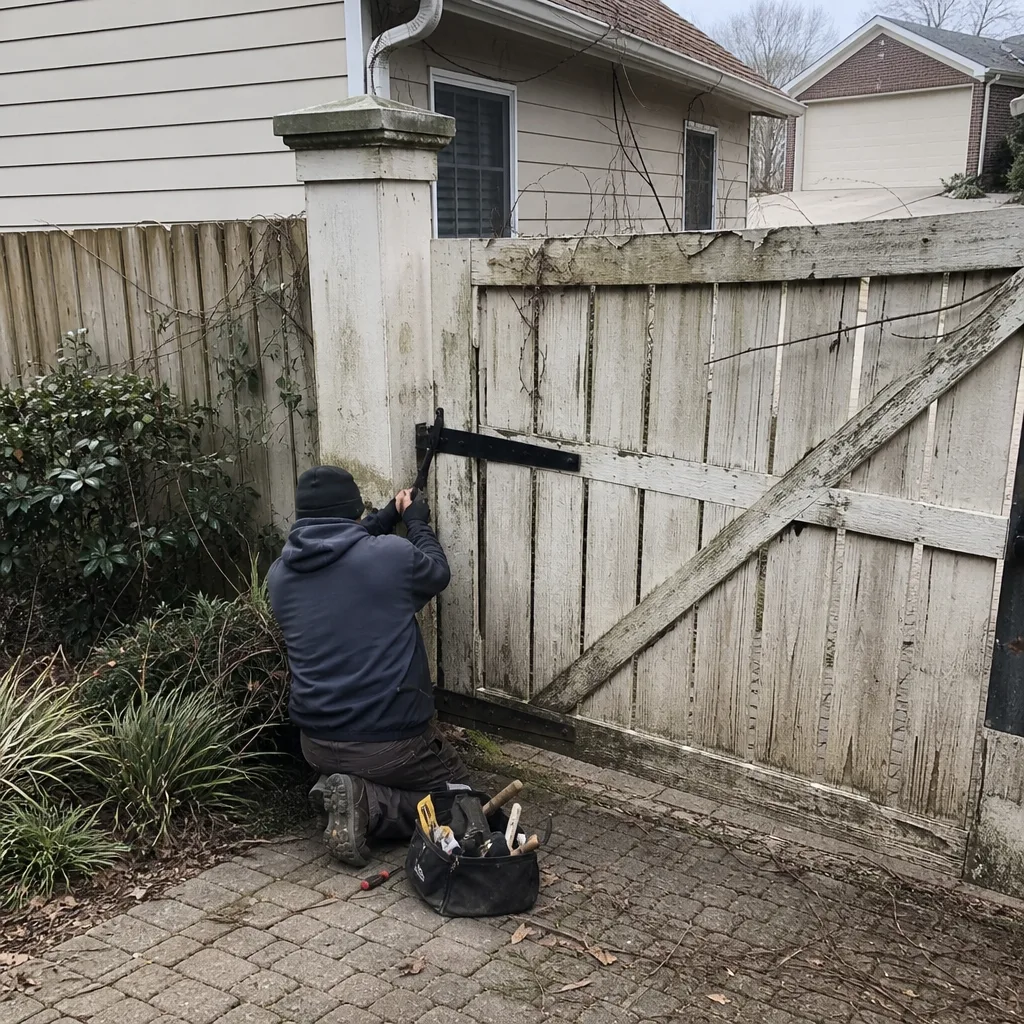 Before
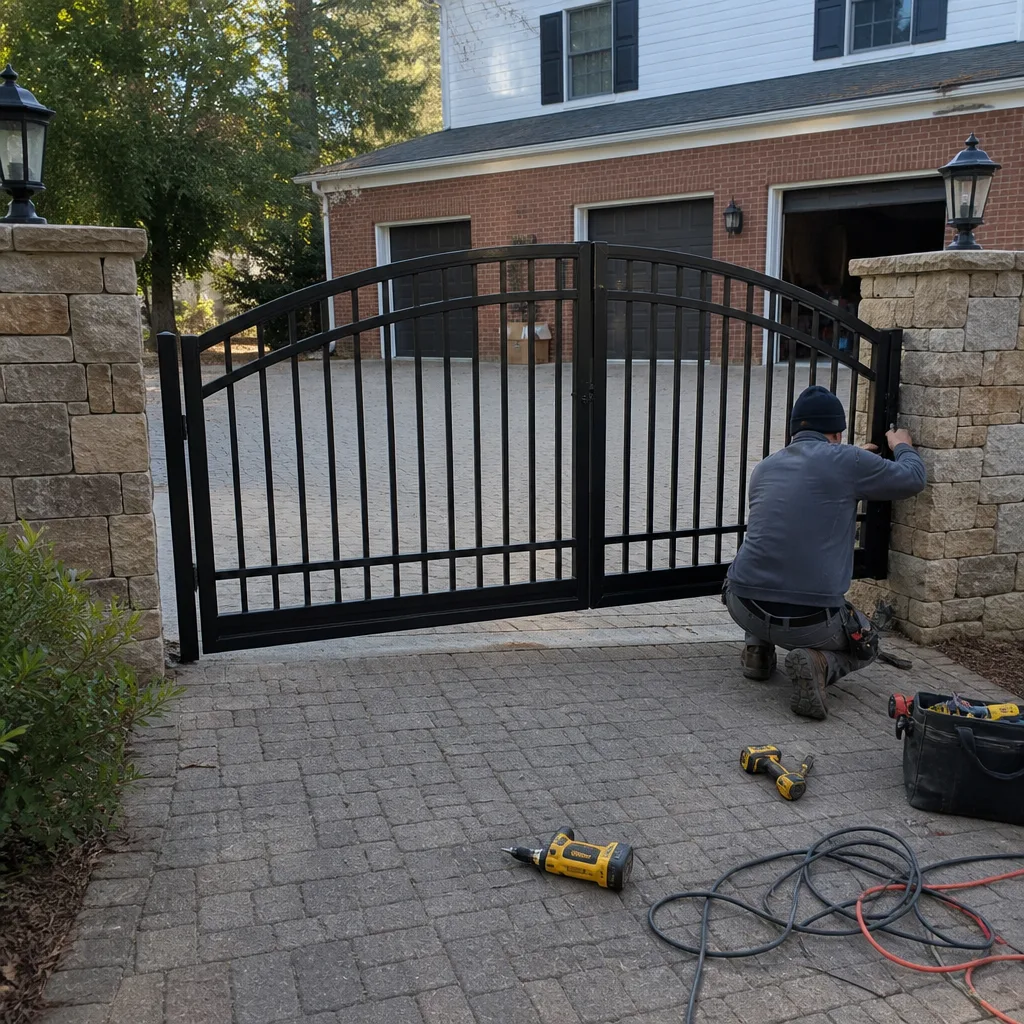 After
After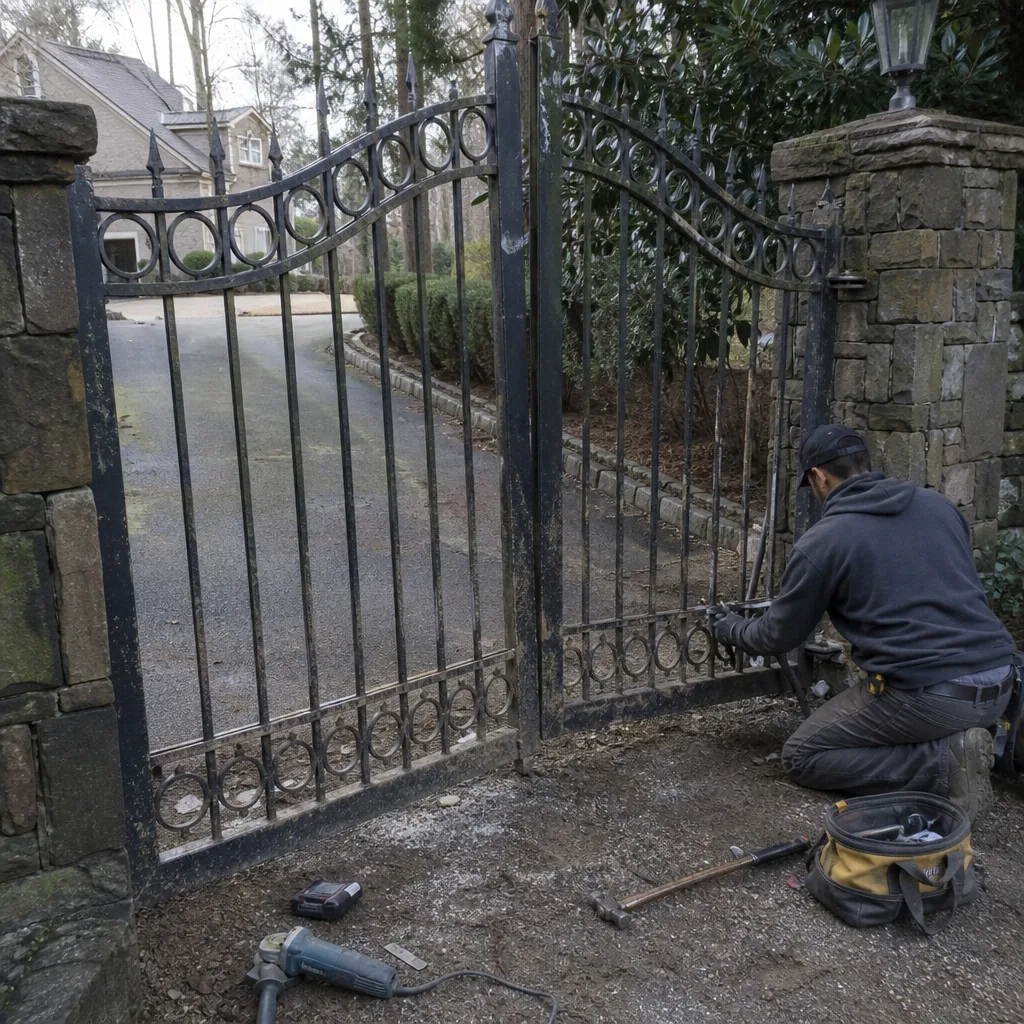 Before
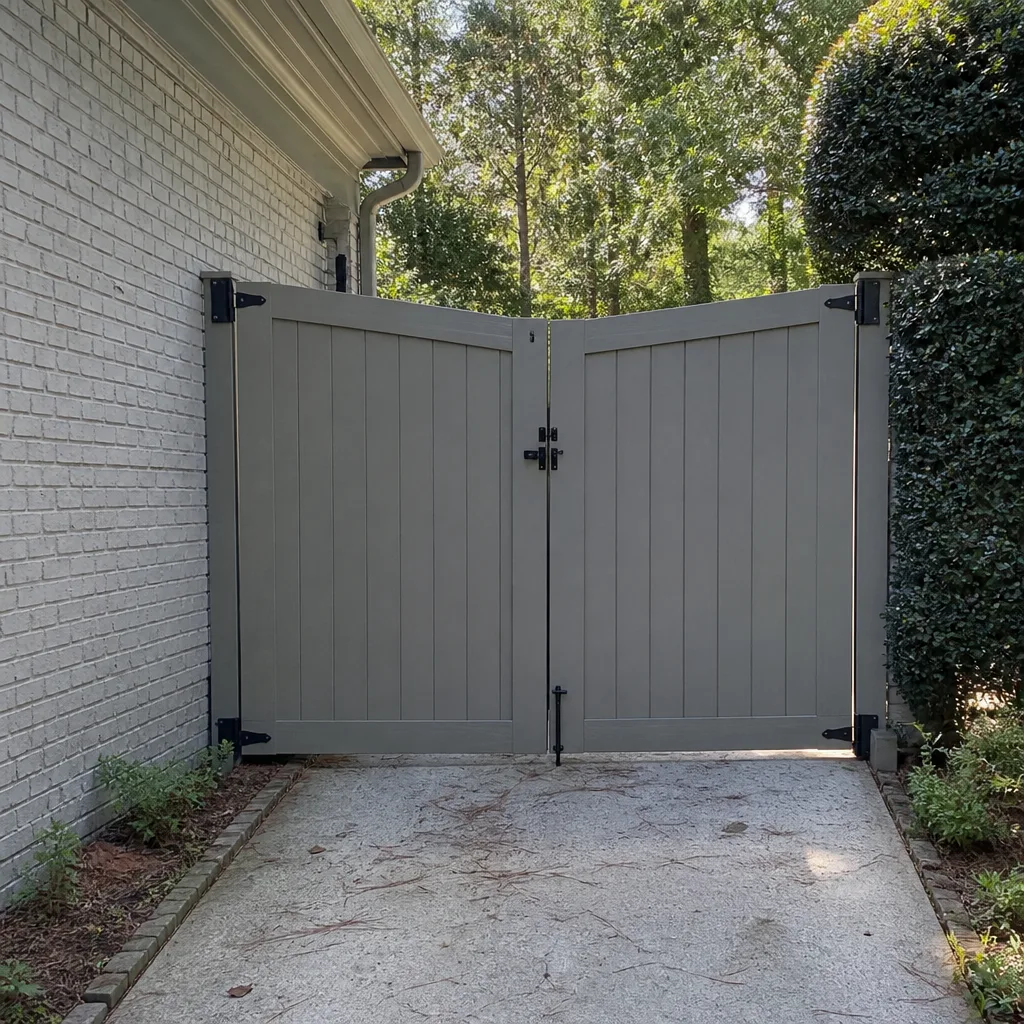 After
AfterGate Repair Warning Signs: A Johns Creek Homeowner’s Reference Guide
A gate that slows down on cold January mornings and speeds back up by noon is not a motor problem. It’s a battery-backup voltage sag caused by a failing battery that will strand the gate completely on the next hard freeze, usually at 6:47 PM when you’re carrying groceries through a downpour. Most warning-sign guides list symptoms alphabetically or by gate type, which leaves a Johns Creek homeowner unable to tell whether to call for Gate Repair today or schedule for next quarter. This reference sorts every sign by what it means mechanically and how long you have before the failure escalates. You’ll learn to read fault logs, distinguish slide-gate grinding from swing-gate grinding, and document what you see so the technician arrives with a starting point instead of a blank diagnostic.
Quick Answer
Gate repair warning signs fall into three urgency tiers: immediate safety stops (unexpected reversing, failure to hold on a slope, or a gate that moves without command), 30-day action items (slow operation, new noises, or intermittent remote response), and 90-day monitoring items (cosmetic rust, minor post lean, or weatherstripping wear). In Johns Creek, clay-soil settling adds a fourth category unique to this market: post tilt and track-gap changes that appear gradually after heavy rain seasons and worsen during freeze-thaw cycles.
Table of Contents
- Tier 1: Immediate Safety Stops - Call Today
- Tier 2: Thirty-Day Action Items
- Tier 3: Ninety-Day Monitoring
- Sound-Based Diagnostics: What Each Noise Means
- Johns Creek Clay-Soil Warning Signs
- Reading Your Operator’s Fault Log Before Failure
- What to Document Before the Technician Arrives
- Common Mistakes to Avoid
- When to Call a Professional
- Frequently Asked Questions
BeforeAfterTier 1: Immediate Safety Stops - Call Today
These signs indicate a condition where the gate could cause injury, property damage, or leave your property unsecured. Do not attempt to adjust, disable, or bypass the safety systems yourself.
Unexpected Reversing
When a gate begins to reverse direction without an obstruction, the safety system is either hypersensitive or cross-wired. In our experience across Johns Creek, this most often traces to photo-eye misalignment after a landscape crew bumps the bracket, or to a failing edge sensor sending capacitance drift. The mechanical cause: the operator receives a false “obstruction detected” signal and executes its programmed reverse cycle. On a gate motor & opener in Johns Creek, this is not a setting to tweak. It’s a wiring or component fault that requires testing with a multimeter and a sequence analyzer. We’ve seen gates reverse into vehicles because the owner adjusted the force setting upward instead of fixing the sensor.
What to do: Stop using the gate. Use the manual release and secure the gate in the closed position. Document whether the reverse happens during opening, closing, or both, and whether it occurs at the same point in travel each time.
Failure to Hold on a Slope
A swing gate on a Johns Creek driveway with even modest grade that drifts open or closed when the motor is not running has a failed magnetic brake or mechanical latch, or the post has tilted enough to change the geometry and overload the hold circuit. This is a safety stop because the gate can accelerate downhill and strike a person or vehicle. The magnetic brake inside a Linear or Viking operator should hold 200+ pounds of gate leaf; if it doesn’t, the brake coil has degraded or the control board is not sending hold voltage.
What to do: Do not rely on the motor to hold the gate. Secure it with a physical chain or latch, and call for same-day service. Note the approximate grade percentage if you can estimate it, and whether the drift started suddenly or worsened over weeks.
Gate Moves Without Command
Phantom operation - the gate opens or closes with no remote pressed, no keypad code entered, no vehicle loop triggered - indicates a control board fault, a shorted low-voltage wire, or radio frequency interference from a neighbor’s new equipment. In 2019, we diagnosed a Johns Creek property in Country Club of the South where the gate opened twice nightly at 2:17 AM. The cause was a failing transformer in an adjacent irrigation controller sending 24VAC ripple through shared trench wiring. The gate itself was fine; the electrical environment was not.
What to do: Cut power at the breaker, not just the operator disconnect. Phantom operation with power off indicates a stored-energy fault in the control board capacitors. Document the time pattern if there is one.
Visible Cable or Spring Damage on a Slide Gate
Slide gates with chain-drive or cable-drive systems that show kinked cables, broken strands, or a chain that rides over the sprocket teeth are in immediate failure territory. A broken cable on a 600-pound slide gate releases that load unpredictably. We’ve replaced cables on gates in Johns Creek where the homeowner had been “meaning to call” for three weeks and the cable finally parted during a school-day departure, blocking the driveway with a gate half in the track.
Safety caveat: Gate cables and chains are under significant tension. Do not attempt to adjust, tension, or replace them yourself. The stored energy in a loaded cable can cause serious laceration or crush injury. This work requires proper anchoring, tension gauges, and knowledge of the operator’s torque limits.
Tier 2: Thirty-Day Action Items
These signs indicate progressive wear or calibration drift. The gate still functions, but the underlying fault is accelerating. Schedule service within 30 days to avoid escalation to Tier 1, or see our Seasonal Gate Repair Care for Johns Creek: Year-Round Homeowner’s Guide for maintenance timing.
Slow Operation with Temperature Correlation
The battery-backup voltage sag we described in the opening is the classic example. A 12V sealed lead-acid battery in a Ghost Controls or Mighty Mule operator loses cranking amps as temperature drops. At 40°F, a battery at 50% capacity may still operate the gate; at 25°F, it cannot. The motor draws more current, moves slower, and the control board may throw a low-voltage fault. By the time the gate stops entirely, the battery has often sulfated beyond recovery, and you’ve also stressed the motor windings.
In Johns Creek, we see this pattern reliably during the first hard freeze of January. The battery that was “fine in November” fails in January because the temperature coefficient crossed the threshold. A replacement battery installed preventively in October costs less than an emergency call plus possible motor damage.
Intermittent Remote Response
A remote that works from 50 feet on Tuesday and requires 10 feet on Thursday is not a remote battery issue if the battery is fresh. The pattern indicates either a degrading receiver antenna, increasing RF interference, or a control board with cold-solder joints that open and close with thermal cycling. We document antenna readings in our job records; a healthy receiver shows -30 dBm at 100 feet, and we flag anything below -45 dBm for antenna or coax replacement.
New Grinding That Varies with Load
Grinding that appears only when the gate is moving uphill or against wind indicates a motor working beyond its rated duty cycle, or a gearbox with depleted lubricant. The sound changes because the mechanical load changes. This is distinct from constant grinding, which usually indicates a physical obstruction or bearing failure. We’ll detail sound diagnostics in the next section.
Keypad or Intercom Response Delay
A keypad that accepts the code but delays gate movement by 2-4 seconds suggests a failing relay on the control board or voltage drop in the low-voltage run. The delay is the time it takes the weakened relay to pull in, or the time for capacitors in the power supply to recharge between operations. In Johns Creek’s older neighborhoods like Rivermont and Abbots Run, we’ve found 18-gauge low-voltage runs exceeding 200 feet that were marginal when installed and have degraded with ground moisture intrusion.
Tier 3: Ninety-Day Monitoring
These are wear indicators that do not yet affect function. Document them, photograph them, and schedule maintenance during a convenient window.
- Surface rust on steel components: Johns Creek’s humidity averages 70% year-round, and galvanized coatings degrade over 8-12 years. Surface rust on hinges or track brackets is cosmetic until it penetrates to structural section. Wire-brush, prime, and paint, or schedule welding repair before section loss exceeds 10%.
- Minor post lean under 2 degrees: Measure with a level or phone app. Under 2 degrees is monitoring territory; over 3 degrees, the gate geometry changes enough to stress the operator. Clay soil in Johns Creek swells and shrinks; a post that leans 1.5 degrees in July may lean 3.5 degrees in January after freeze-thaw.
- Weatherstripping compression set: The rubber seal between gate and post or gate and ground that no longer springs back to original shape. This admits water and accelerates rust but does not affect operation immediately.
- Paint chalking or UV degradation: Powdery surface on aluminum or coated steel indicates the UV barrier has failed. Re-coat before substrate oxidation begins.
- Control board capacitor bulging: Visible through the operator housing vents, bulging or leaking capacitors are early indicators of power-supply degradation. They may function for months or fail tomorrow; replacement is preventive, not urgent.
Sound-Based Diagnostics: What Each Noise Means
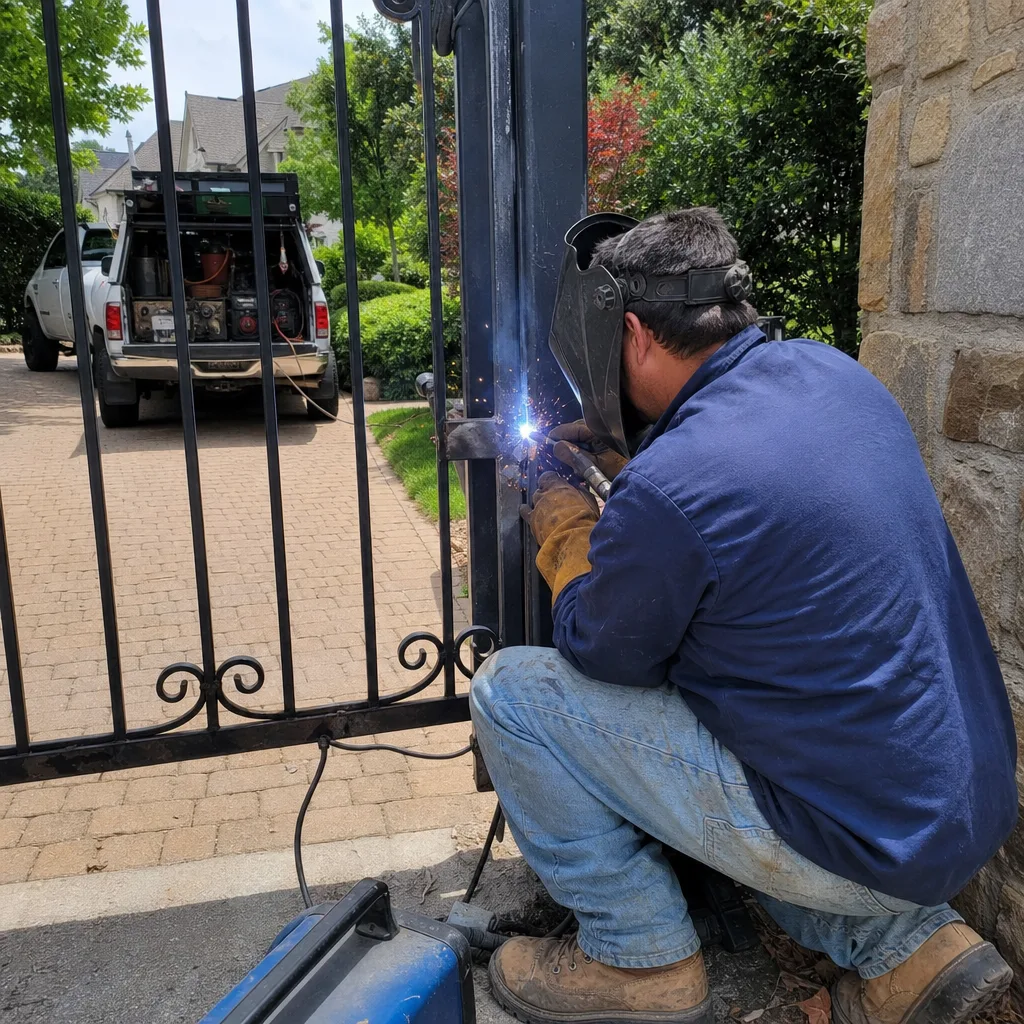
The same sound means different things in a slide gate versus a swing gate because the mechanical loads and failure modes differ. Here’s what we listen for on a gate repair in Johns Creek call.
Grinding
Slide gate: Grinding in a slide gate usually indicates roller-wheel bearing failure or track contamination. The V-groove wheels ride on an angle-iron track; when bearings seize, the wheel slides instead of rolls, producing a metallic grind. We’ve found gravel, pine needles, and even squirrel nests in tracks across Johns Creek properties. The sound is constant through the travel cycle because the wheel is always in contact.
Swing gate: Grinding in a swing gate indicates hinge-pin galling or operator gearbox wear. The hinge pin rotates in a bushing or bearing; without lubricant, steel-on-steel contact produces a low-frequency grind that often varies with gate weight distribution. Gearbox grinding in a Linear or DoorKing operator is higher-pitched and may change when the gate changes direction, because the worm gear loads the opposite flank.
Clicking
Slide gate: Rhythmic clicking that matches chain or cable pitch indicates a sprocket tooth engaging a damaged chain link, or a cable end fitting catching on the guide bracket. The click repeats at consistent intervals.
Swing gate: Clicking at start of travel, then silence, indicates a limit-switch cam passing its trigger point out of sequence. The control board hears the click, expects the gate to stop, and when it doesn’t, throws a fault. This is common after a power surge or manual operation that moved the gate without the operator tracking position.
Stuttering or Cogging
A motor that starts, stops, starts, stops in rapid succession is cogging - the motor cannot develop enough torque to overcome starting inertia. In a slide gate, this is often a track obstruction or a gate that has shifted and binds in the guide rollers. In a swing gate, it’s typically a post tilt that has changed the geometry and increased the effective gate weight, or a failing start capacitor in a single-phase motor. The stutter pattern is the same, but the cause and repair differ completely.
High-Pitched Whine
A motor that whines without moving indicates a locked rotor - the electrical side is energized but the mechanical side cannot turn. This will burn the motor windings within minutes if power remains applied. The operator’s thermal overload should trip, but if it’s failed or bypassed, the motor is destroyed. This is an immediate power-off situation.
Johns Creek Clay-Soil Warning Signs
Johns Creek sits on the Georgia Piedmont’s clay-rich residuum, specifically the Cecil soil series and its associates. These clays have high shrink-swell potential, meaning they expand when wet and contract when dry, often by several inches in the top 36 inches of profile. This geology creates warning signs that don’t appear in sandy-soil markets.
Post Tilt Thresholds
Gate posts in Johns Creek should be set in concrete piers extending below the seasonal moisture-active zone, typically 30-36 inches. When clay swells, it exerts lateral pressure on the pier; when it shrinks, it creates a gap that allows water to penetrate and accelerate the next swell cycle. The visible sign is post tilt that worsens after heavy rain and may partially correct during drought.
We measure post tilt on every service call and record it in the job photo log. A tilt under 2 degrees is monitoring territory. At 2-3 degrees, the gate geometry changes enough that the operator arm or chain pull is no longer coaxial with the gate’s intended line of travel. This increases bearing load and accelerates wear. Over 3 degrees, the gate may bind in its travel or the operator may exceed its torque limit and fault out.
In neighborhoods like St. Ives and The Falls of Autry Mill, we’ve documented post tilts that progressed from 1.5 degrees to 4 degrees over a single wet winter, then stabilized after a dry summer. The key is measuring and recording, not guessing.
Roller Track Gaps
Slide gates depend on consistent track elevation. When clay soil swells beneath a track section, the track rises relative to the gate frame; when it shrinks, the track drops. The visible sign is a gap between the roller wheel and track that appears and disappears seasonally, or a gate that binds at one point in travel during wet weather and runs freely when dry.
Permanent correction requires either a floating track mounting system or deeper pier foundations that isolate the track from surface soil movement. Shimming the track seasonally is a temporary measure that we document but do not recommend as a long-term solution.
Arm Geometry Changes
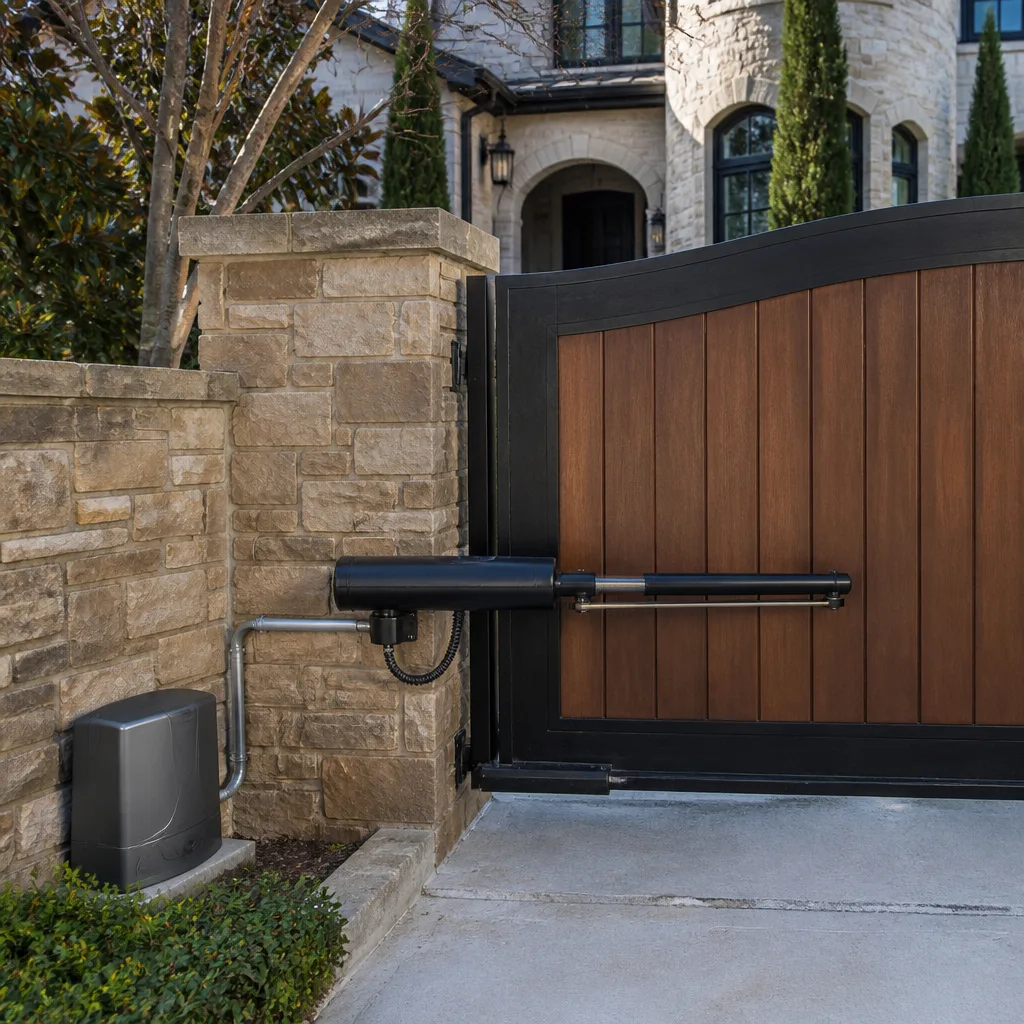
Swing gate operators use either a linear actuator (ram arm) or an articulating arm. Both depend on precise geometry: the arm must pull or push along the gate’s center of mass without introducing twist. When a post tilts, the arm attachment point moves, and the geometry becomes non-optimal. The visible sign is an arm that appears angled when the gate is fully open or closed, or an operator mounting bracket that shows fresh stress marks or bolt elongation.
We’ve replaced operator arms in Johns Creek where the geometry had degraded so far that the arm was effectively trying to twist the gate leaf off its hinges. The homeowner’s warning sign was “a little more noise lately.”
Reading Your Operator’s Fault Log Before Failure
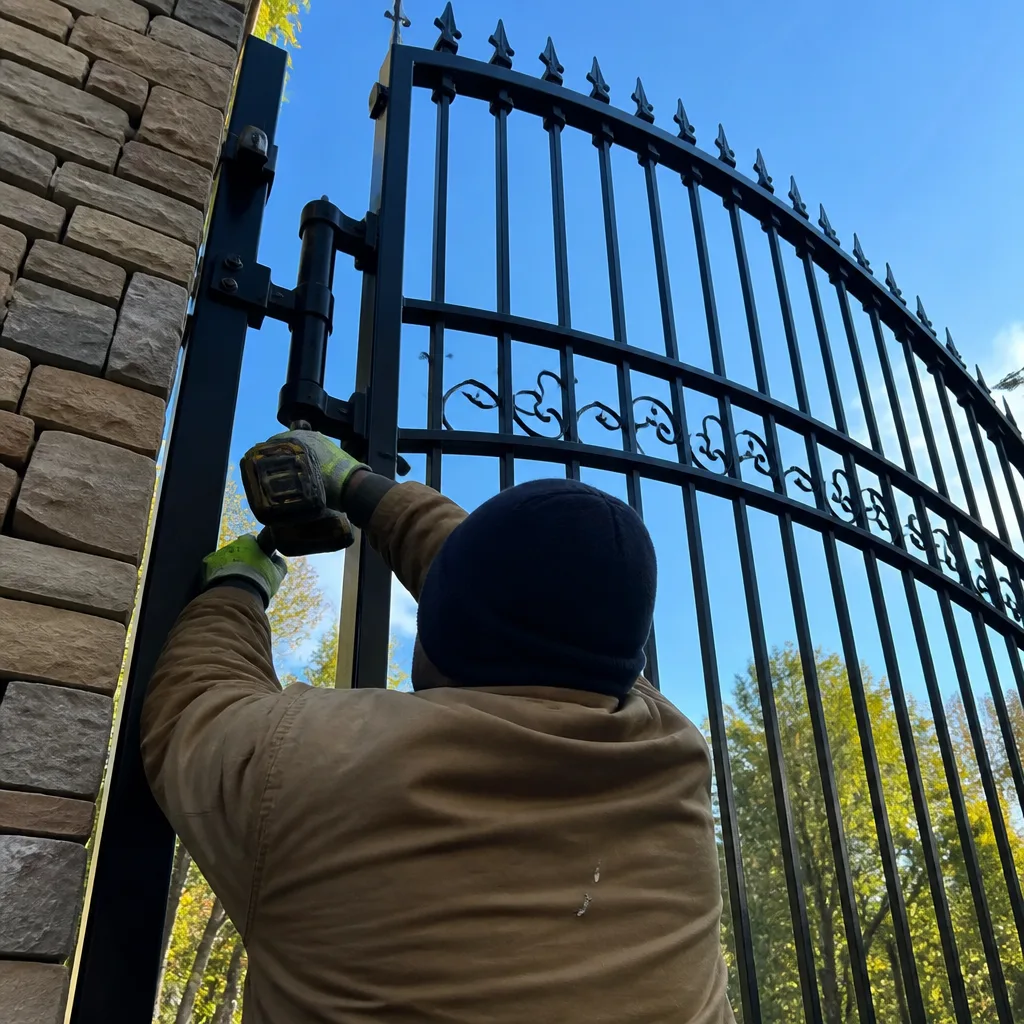
Modern gate operators record faults in non-volatile memory before the fault becomes a visible symptom. Retrieving this log gives a technician a timeline of degradation rather than a single-point snapshot. Here’s how to access logs on the four most common residential operators we service in Johns Creek.
- LiftMaster LA400 / LA500 series: Press and hold the “Learn” button for 6 seconds until the LED blinks. Release, then press briefly three times. The LED will flash a two-digit code: 1-1 is obstruction detected, 1-2 is excessive force, 2-1 is low battery, 3-1 is thermal overload. Count the flashes and record the sequence. The log stores the last 10 faults with no timestamp, so the order is reverse chronological.
- Linear Pro Access (OSL, ACT series): Remove the control cover and locate the diagnostic LED near the terminal strip. With power on, press the small recessed button labeled “DIAG” once. The LED flashes the active fault; press again to scroll through stored faults. Codes are single-digit: 1 = limit fault, 2 = motor overload, 3 = entrapment, 4 = low voltage, 5 = board fault. Up to 5 faults stored.
- DoorKing 9150 / 9200 series: Enter program mode by holding the “Program” button until the display shows “Pr.” Press “Up” to scroll to “LOG,” press “Enter.” The display shows fault codes with a number prefix indicating how many occurrences: “3-Oh” means three obstruction events. Press “Up” to scroll, “Enter” to clear individual codes, “Program” to exit.
- Viking G-5 / H-10 series: Press and hold “Open” and “Close” simultaneously for 5 seconds. The display shows “dIAG.” Press “Stop” to scroll through fault codes: F01 = main board, F02 = motor thermal, F03 = limit switch, F04 = photo eye, F05 = loop detector. Press and hold “Stop” to exit. Viking stores the last 20 faults with relative time indicators (“2H” = 2 hours ago, “3D” = 3 days ago).
Document what you find, even if you don’t understand it. A log showing “2-1, 2-1, 2-1, 2-1” on a Linear operator tells us the battery has been marginal for four consecutive cycles, and we can test before the gate fails completely. Under Vance Gate Repair Johns Creek home service protocols, we record the fault log in every job file and compare it to the previous visit if we have one.
What to Document Before the Technician Arrives
The Haven Standard requires that we arrive with a starting point, not a blank diagnostic. You can accelerate this significantly by documenting what you observe. Here’s what helps most, and you can find more guides & resources on our blog.
Photograph These Specific Views
- Full gate from inside the property, showing the full travel path
- Full gate from outside, showing approach angle and any grade
- Operator mounting and arm geometry, with the gate fully closed
- Same operator view with gate fully open
- Close-up of any visible rust, cable wear, or track gaps
- Control board LED status with power on and gate idle
- Any fault code displayed on the operator screen or remote panel
Record These Measurements and Observations
- Post tilt in degrees (phone level app is sufficient)
- Approximate gate dimensions and estimated weight if known
- Time of day when the symptom occurs, if intermittent
- Temperature at time of symptom, if seasonal
- Frequency: every cycle, once daily, random, etc.
- Whether the symptom occurs from all control methods (remote, keypad, vehicle loop, manual)
Preserve the Fault Log
As described above, retrieve and photograph the fault log display before any power cycle or reset. Some operators clear the log on power loss; others retain it. Don’t risk losing the timeline.
When you call gate installation in Johns Creek or repair service, we’ll ask for this documentation. If you email photos ahead, our technician reviews them before dispatch and arrives with likely parts rather than making a diagnostic trip followed by a return trip with components. This is particularly valuable for operators like Viking and DoorKing where control boards are brand-specific and not stocked by general suppliers.
Common Mistakes to Avoid
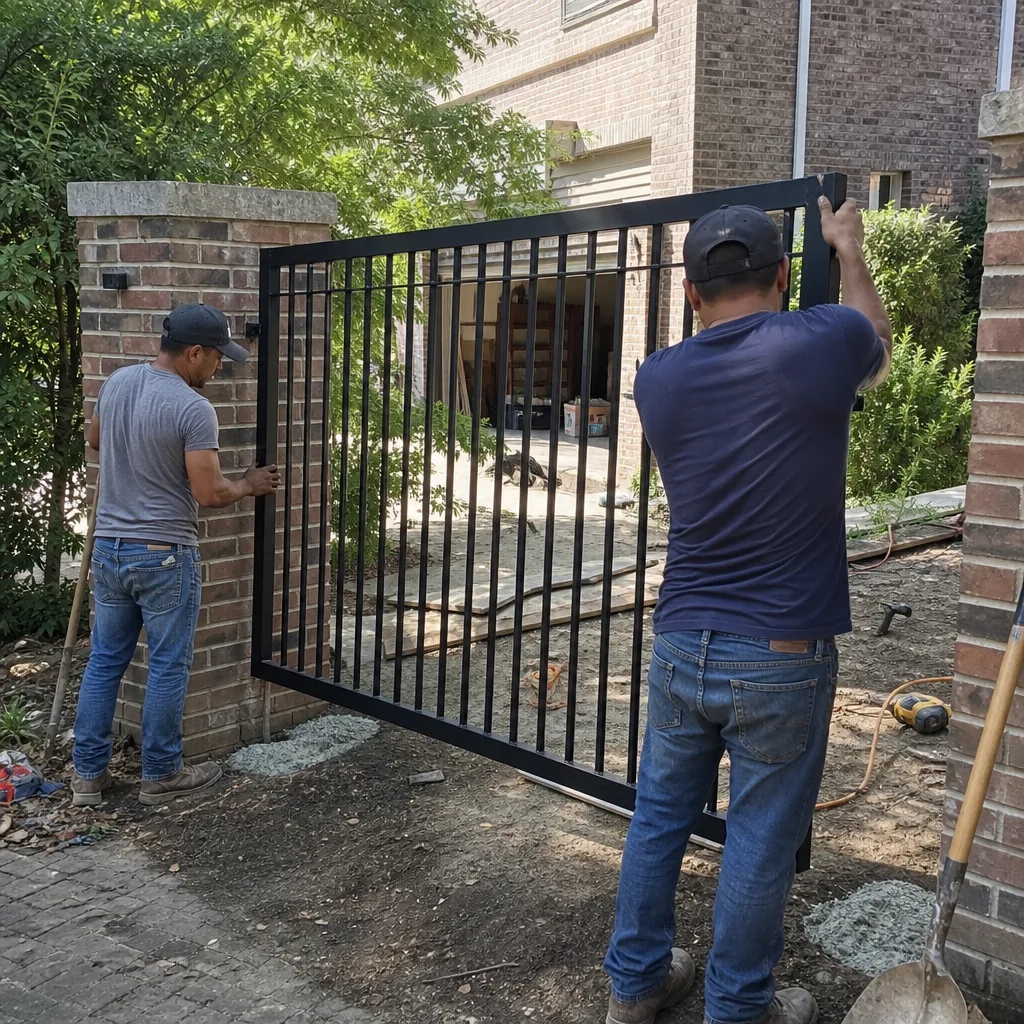
- Adjusting force settings upward to compensate for mechanical binding: The force potentiometer or digital setting on a gate operator is a safety limit, not a tune-up knob. Increasing force to overcome a binding track or tilting post defeats entrapment protection and risks crushing injury. In Johns Creek, we’ve seen this done by homeowners and by technicians who should know better.
- Disconnecting safety devices to “stop the beeping”: A photo-eye that beeps indicates misalignment or fault. Removing it from the circuit eliminates the noise and the protection. The gate will operate without it until someone walks through the beam path at the wrong moment.
- Ignoring seasonal patterns: A gate that “always acts up in winter” is telling you something specific about battery capacity, grease viscosity, or soil movement. Treating it as random bad luck means you’ll replace components that aren’t the root cause.
- Using generic lubricants on gate components: White lithium grease on a chain in Johns Creek’s humidity attracts grit and forms an abrasive paste. We use specified lubricants for each application: chain-specific compound for chains, molybdenum-disulfide for slide tracks, silicone for weatherstripping.
- Measuring post tilt once and forgetting it: Clay soil moves. A measurement in June is not valid in February. We record tilt at every visit and plot the trend; a homeowner doing the same catches acceleration before it becomes failure.
- Calling for “a tune-up” without describing symptoms: A tune-up without a complaint list is just lubrication and visual inspection. It misses the intermittent fault that only happens at 7 AM when the battery is cold. Describe the symptom, not the desired service.
- Accepting verbal estimates for significant repair: Under the Haven Standard, we provide a written scope and written price before any work starts. If another company offers a verbal estimate and a handshake, you have no documentation of what was promised or what was actually done.
When to Call a Professional
Call today for any Tier 1 safety stop: unexpected reversing, failure to hold on a slope, phantom operation, or visible cable or spring damage. These conditions can cause injury or property damage, and they do not improve with time.
For Tier 2 and Tier 3 signs, you have discretion on timing, but earlier service prevents the escalation that turns a 30-day item into an emergency call. In Johns Creek’s climate, a battery showing voltage sag in October will fail in January; a post tilting 2 degrees in September may bind the gate at 3 degrees in March.
Vance Gate Repair Johns Creek offers free estimates in Johns Creek. We’ll review your documentation, retrieve the fault log if you haven’t, and provide a written scope and written price before any work starts under Haven Standard Clause 1. If you’re comparing options, read our How to Hire a Gate Repair Contractor in Johns Creek: A Step-by-Step Guide first. Our technicians are background-checked and uniformed; you’ll receive a name and photo before arrival. Call (678) 394-1765 to schedule or to email documentation ahead of the visit.
Frequently Asked Questions
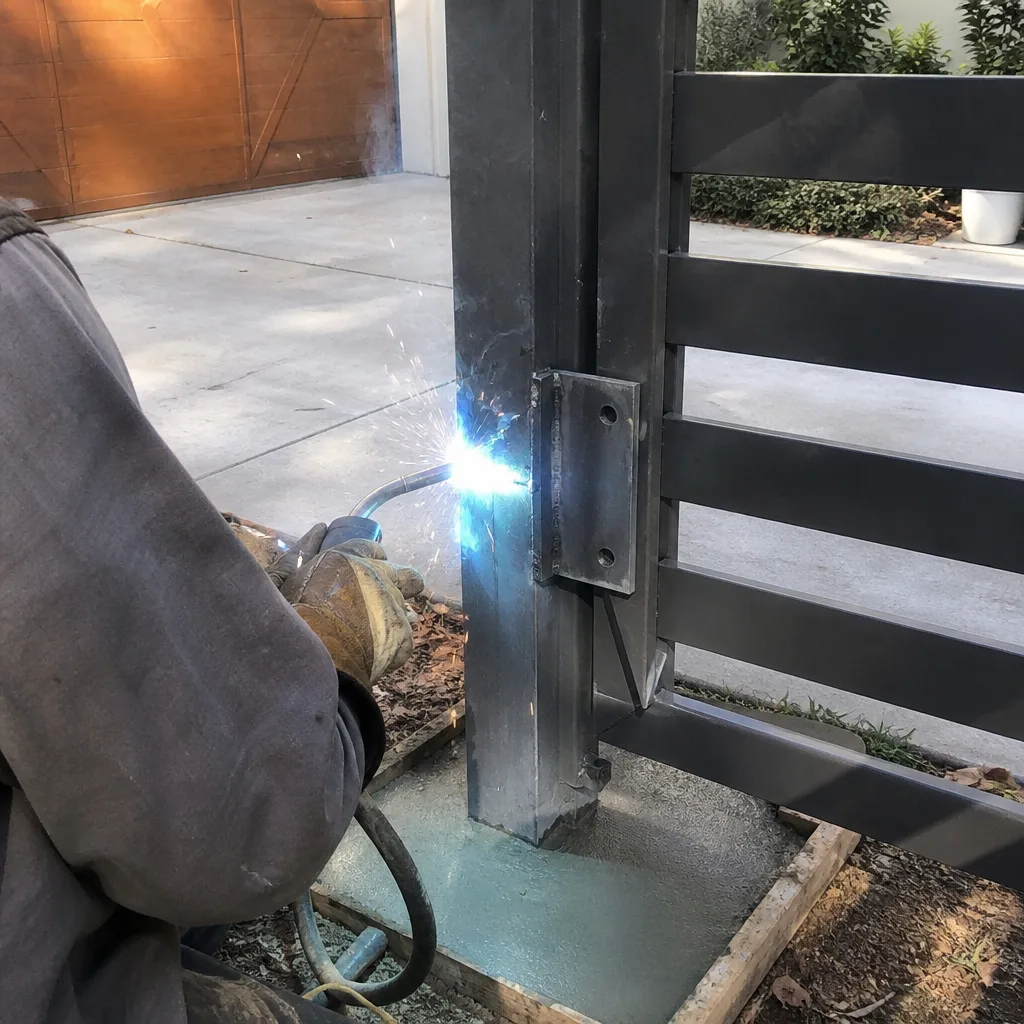
Most residential gate repairs in Johns Creek range from $180 for a limit-switch adjustment or photo-eye realignment to $650 for a motor replacement with programming. A full control board replacement on a multi-brand compatible system typically runs $340-$520, depending on whether the existing enclosure and wiring harness are reusable. We provide a written price before any work starts, and our free second-opinion service will review any written estimate from another company at no charge. Call (678) 394-1765 for an exact quote on your specific symptom.
Same-day service is available for Tier 1 safety stops and most Tier 2 operational failures if you call before 2 PM. We stock common components for Linear, Viking, Ghost Controls, and DoorKing operators, and our Johns Creek warehouse carries track hardware, photo-eyes, and safety edges. Installation work and major welding repairs are scheduled, not same-day, because they require measurement and material ordering. A live person answers our phone 24 hours a day, seven days a week, so you can describe the symptom and receive a realistic dispatch estimate at any hour.
A full gate installation in Johns Creek includes the gate fabrication or supply, post setting with concrete piers below the active soil zone, operator mounting with proper arm geometry, all low-voltage and power wiring to code, safety device installation and testing, keypad or access-control integration if specified, and final limit-switch programming with documented settings. We do not subcontract electrical or concrete work; our technicians execute the complete scope. You receive a written price before work starts and a photo record of every stage under Haven Standard Clause 4.
Yes. Every installation we perform includes the 120VAC power run from your existing panel or outdoor receptacle to the operator location, properly grounded and GFCI-protected where required. Safety edges, photo-eyes, and vehicle loops are installed, aligned, and tested as part of the scope. We do not deliver a gate operator without functional safety devices; that would violate our own documentation standards and local code requirements for automatic gate systems.
A motor that has failed due to a single component - a start capacitor, a thermal switch, or a bearing - is typically repairable at 30-40% of replacement cost. A motor with burned windings, seized armature, or repeated thermal failure after component replacement is a replacement candidate. We test winding resistance, insulation resistance, and bearing runout before recommending either path. Our 22,000+ gate record since 2014 shows that roughly 60% of “dead motor” calls are repairable; we document the test results and show you the numbers before you decide.
We service nine major automation brands: LiftMaster, FAAC, BFT, Linear, Viking, Ghost Controls, DoorKing, Elite, and Mighty Mule. We do not steer customers toward replacement with a different brand when their existing operator is repairable. Our warehouse stocks common components for all nine brands, and our technicians carry diagnostic tools specific to each manufacturer’s control protocols. If you have an operator not on this list, call us; we may still be able to assist depending on the fault.
The Bottom Line
Gate warning signs are not equally urgent. Sorting them by what they mean mechanically - immediate safety stops, 30-day action items, and 90-day monitoring - lets you prioritize spending and avoid the emergency premium. In Johns Creek, clay-soil geology adds post tilt and track-gap changes that don’t appear in generic guides; understanding these local factors prevents misdiagnosis. Sound-based diagnostics differ between slide and swing gates, and operator fault logs reveal degradation timelines that visible symptoms hide. Document what you observe, retrieve the fault log before it clears, and demand a written price before any work starts. These habits, combined with a technician who leaves photographic evidence of every adjustment, turn gate maintenance from reactive panic into managed prevention.
Written by Adrian Vance, Owner at Vance Gate Repair Johns Creek, serving Johns Creek since 2014.