
Last updated September 22, 2026
Free on-site gate assessment - hinges, posts, and your LiftMaster or Nice gate operator checked before anything is quoted
The assessment is free and the quote is the invoice.

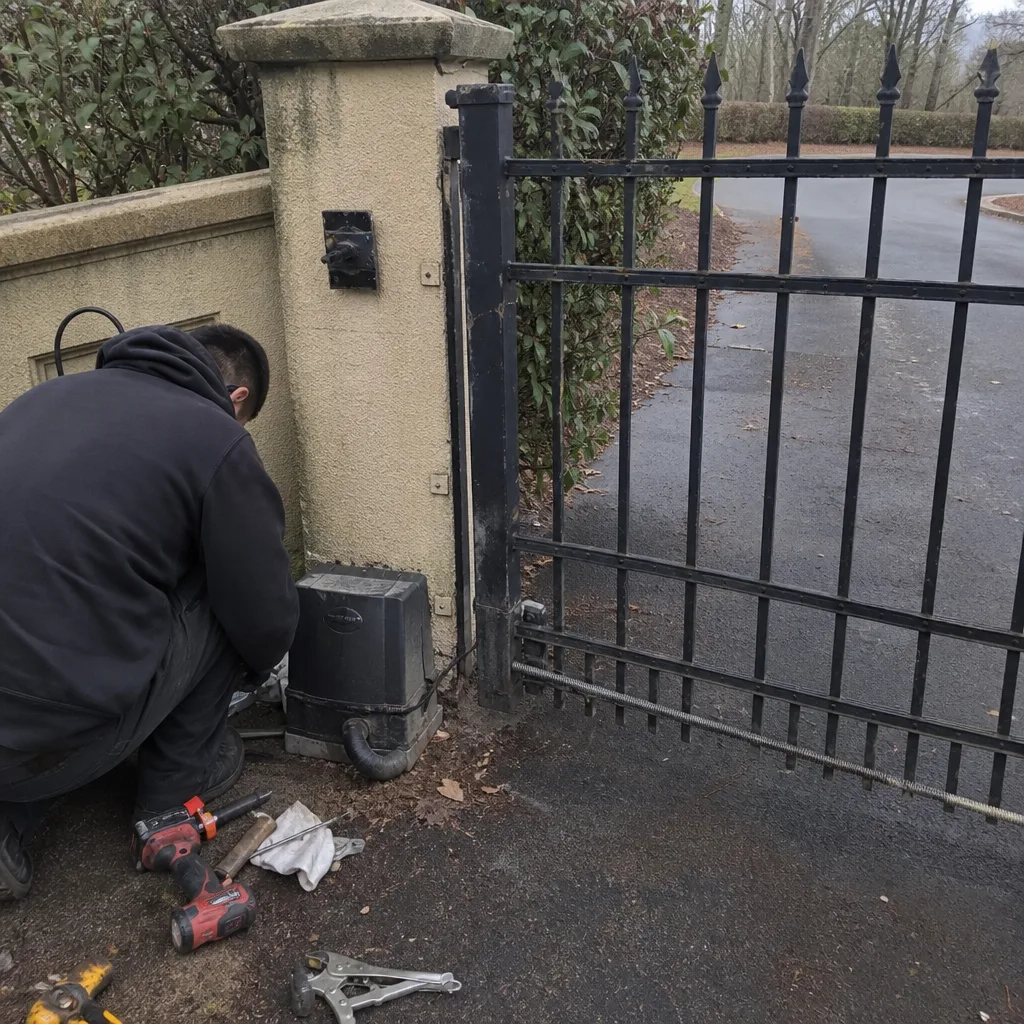 Before
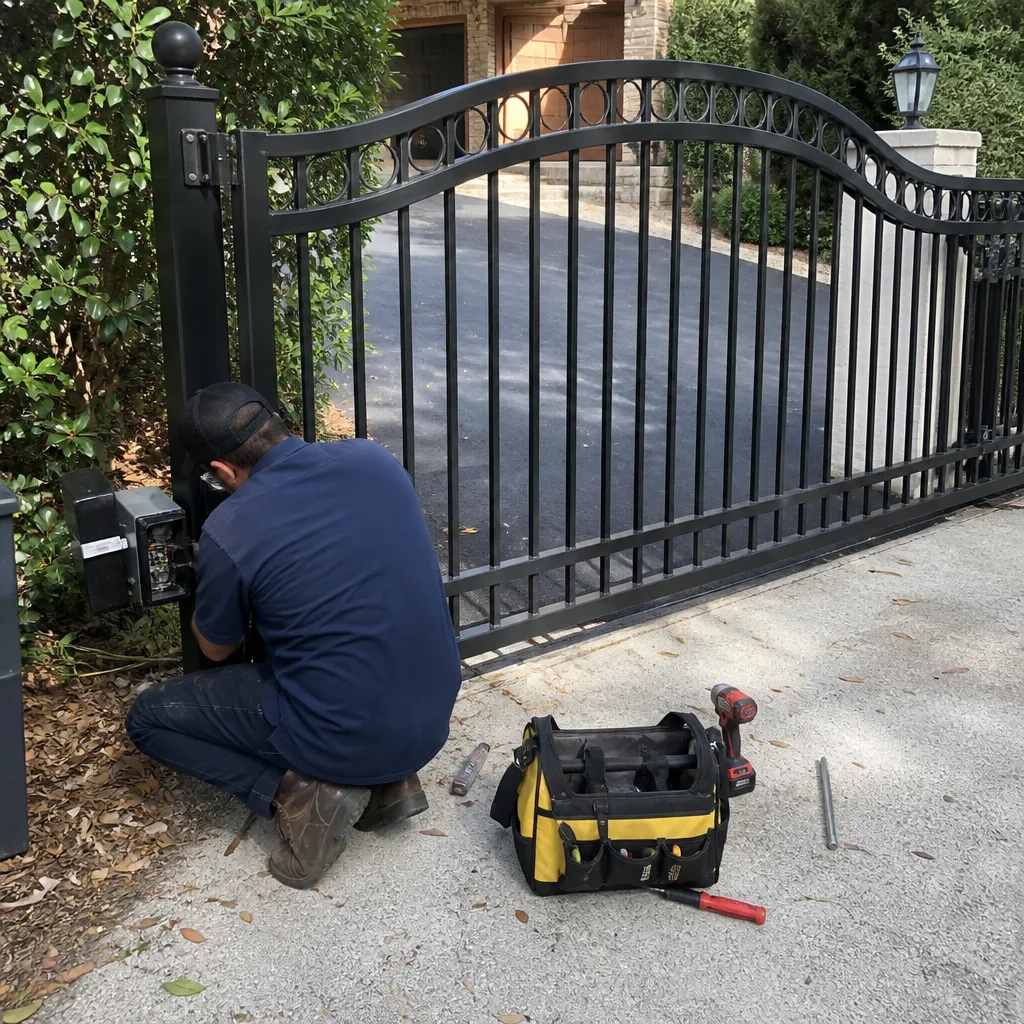 After
After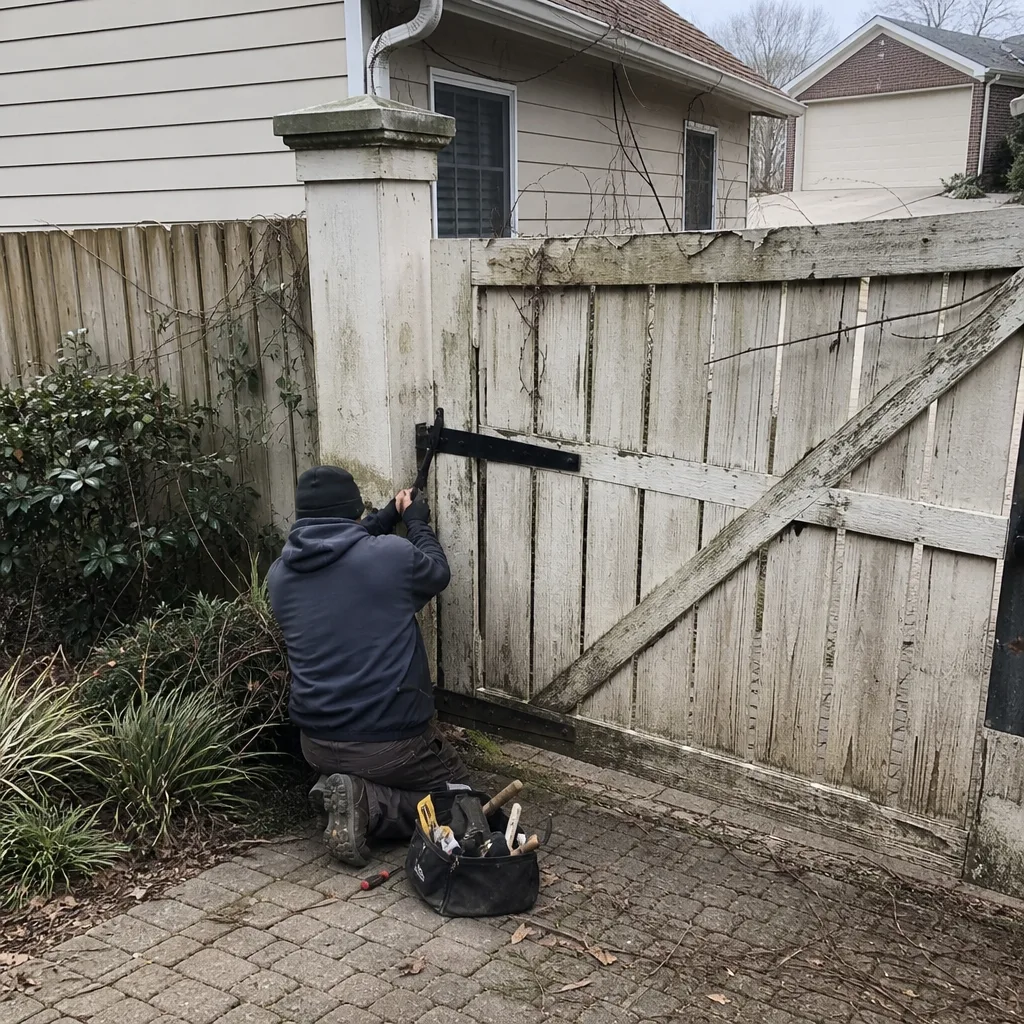 Before
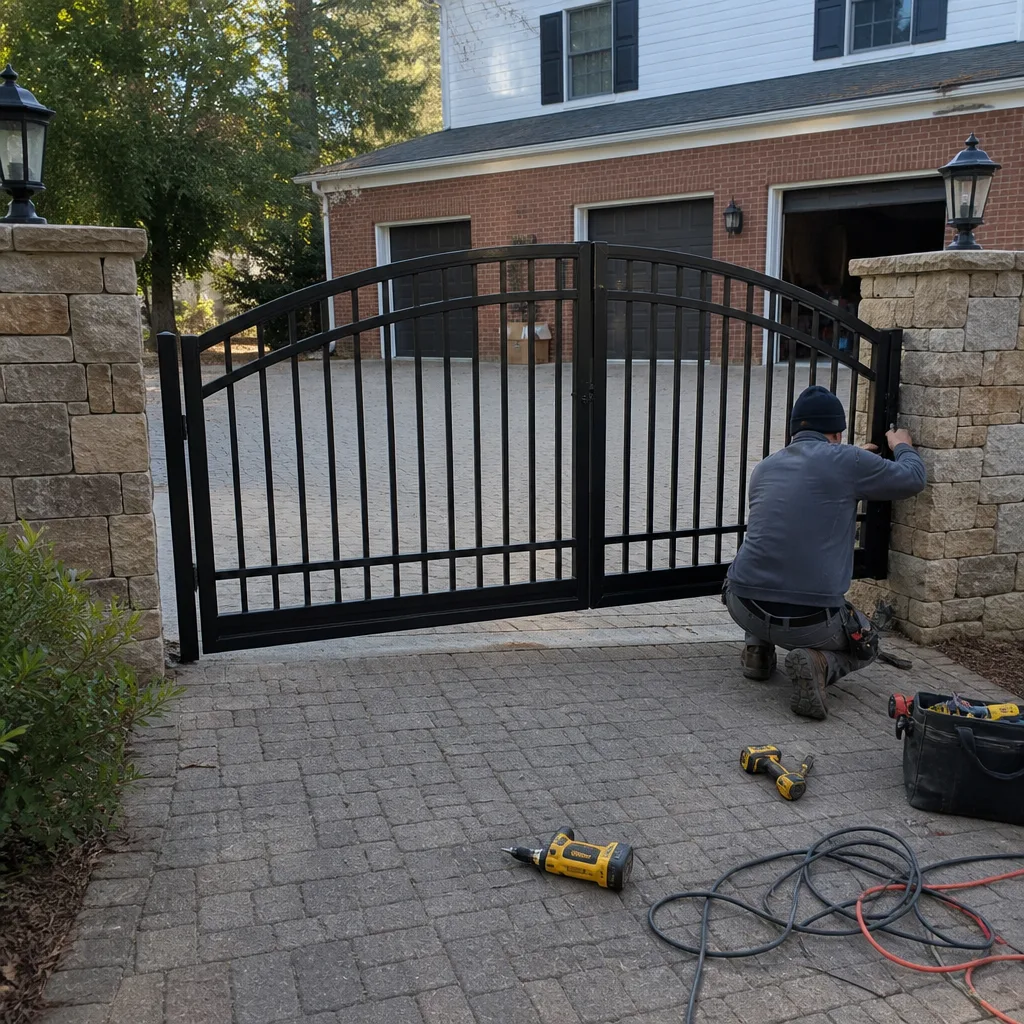 After
After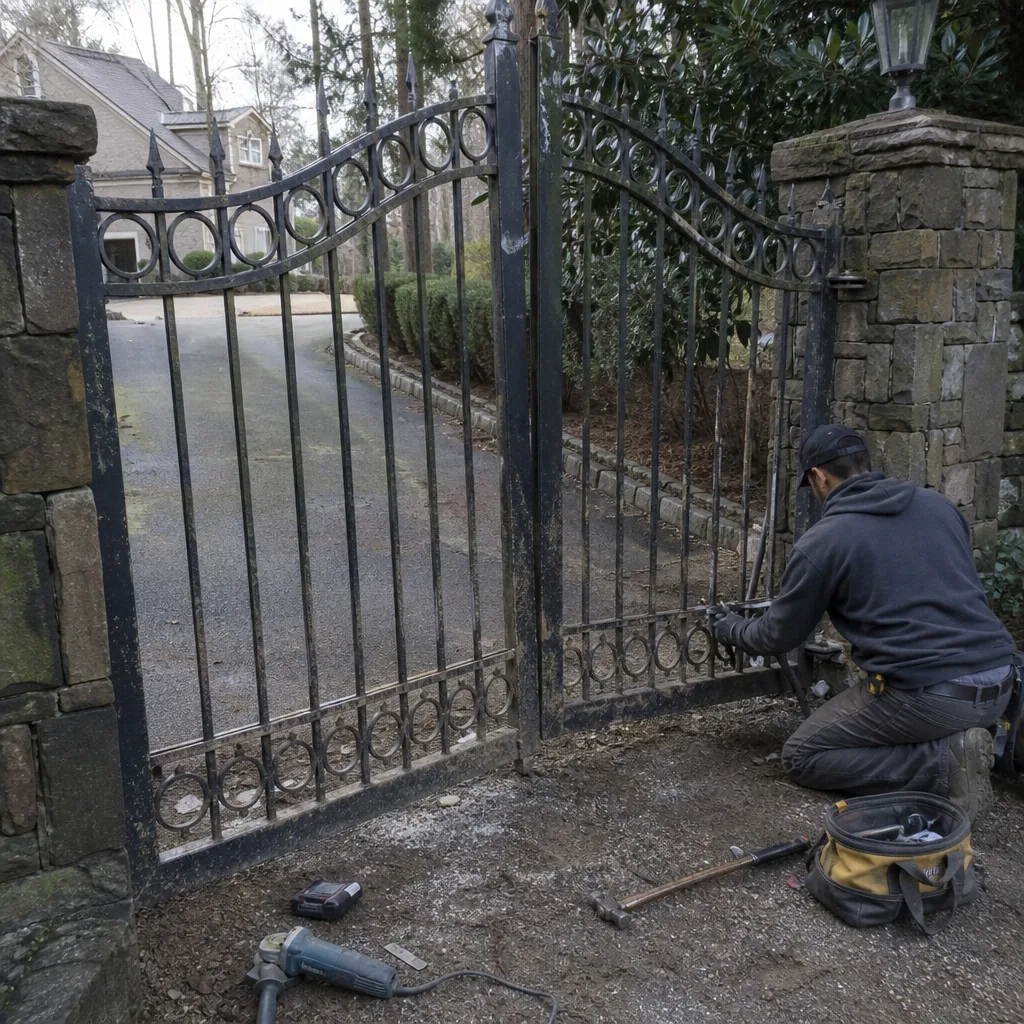 Before
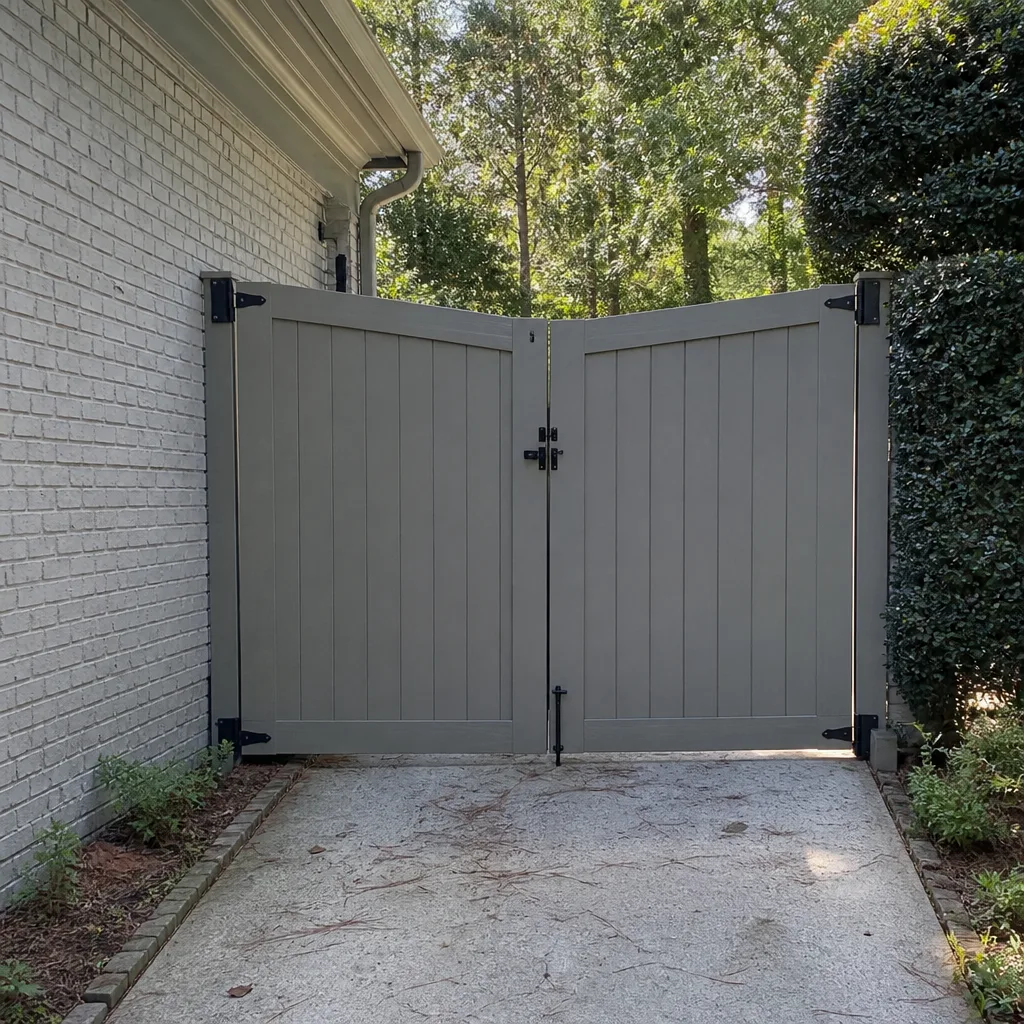 After
AfterThe Complete Guide to Gate Repair in Johns Creek
A gate that reverses unexpectedly and a gate that won’t open at all can share the exact same root cause - a misread limit switch - yet most repair calls treat them as completely different problems. In Johns Creek, we’ve documented the same pattern across thousands of service records: homeowners describe symptoms, technicians chase symptoms, and the underlying failure chain keeps running until it destroys a motor or snaps a rail. This guide maps the three failure chains that actually drive gate problems in our area - mechanical wear, water intrusion at control boards, and limit-switch drift - so you can read your own gate’s behavior, interpret its fault codes, and know whether you’re facing an adjustment, a repair, or a replacement before anyone picks up a tool.
Quick Answer
Gate repair in Johns Creek typically costs $180-$650 depending on whether the issue requires adjustment only, part replacement, or motor rebuild. Most residential swing and slide gate repairs in the 30022, 30024, and 30097 ZIP codes are completed in one visit when the failure chain is correctly diagnosed upfront. The three most common root causes are mechanical wear from clay-soil settling, moisture damage to control boards from Georgia humidity, and limit-switch drift that causes erratic open/close behavior.
Table of Contents
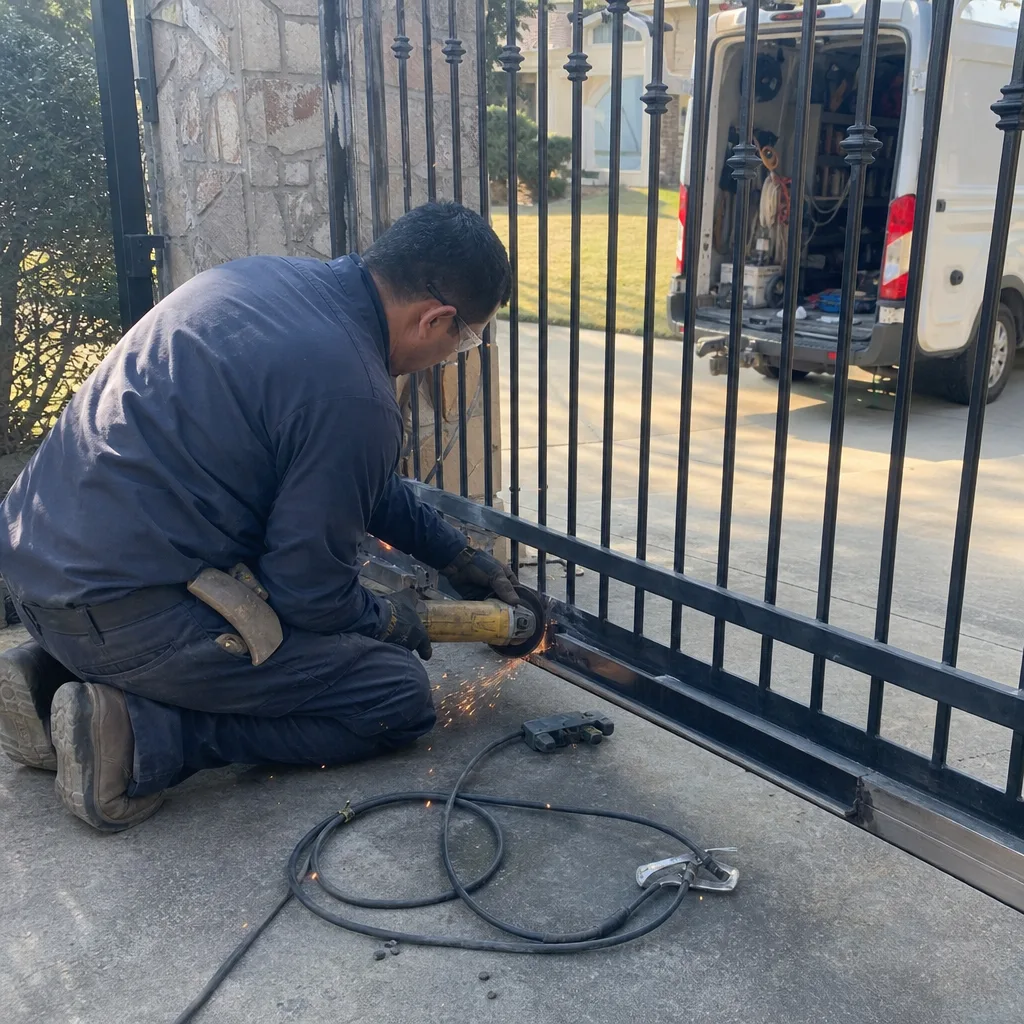
- The Three Failure Chains in Johns Creek Gates
- How to Read Your Gate Operator’s Fault-Code History
- Adjustment vs. Repair: Why the Difference Matters for Your Invoice
- Johns Creek Code Requirements That Change Repair Scope
- What a Complete Post-Repair Record Should Contain
- Brand-Specific Repair Realities: Viking, Ghost Controls, DoorKing, Elite
- What Gate Repair Costs in Johns Creek
- Preventive Maintenance for Johns Creek’s Climate
BeforeAfterThe Three Failure Chains in Johns Creek Gates
Every gate failure we’ve logged since 2014 traces to one of three chains. Knowing which chain you’re in determines whether you need a $180 adjustment or a $1,200 motor replacement.
Failure Chain 1: Mechanical Wear from Clay-Soil Settling
Johns Creek sits on Georgia’s Piedmont clay, which expands when wet and contracts during dry spells. This seasonal movement is not dramatic, but it is relentless. A gate post that was plumb in March can tilt 2-3 degrees by October. That tilt loads the hinge, the operator arm, and the track in directions they weren’t designed to handle.
Physical signs of this chain:
- The gate drags at one point in its swing or slide, then frees up - the drag point moves as the post settles
- Hinge bolts show shiny wear marks where they’ve been grinding against the bracket
- The operator arm or chain makes a rhythmic clunk at the same point in every cycle
- Concrete footing around the post shows fresh hairline cracks, especially after heavy rain
In the Rivermont and Country Club of the South neighborhoods, we see this chain accelerate where irrigation systems keep soil moisture artificially high year-round. The clay never gets its dry-season contraction break. Posts tilt faster. Hinges wear faster. The operator works harder to move a gate that’s progressively out of alignment.
The repair path depends on timing. Caught early, we reset the post, realign the gate, and replace worn hinges. Under Clause 1 of the Haven Standard, we quote that scope in writing before starting. Left unaddressed, the operator arm bends or the rack-and-pinion strips. Then you’re looking at mechanical repair plus operator repair.
Failure Chain 2: Water Intrusion at Control Boards
Georgia humidity averages 70% year-round, with summer spikes above 90%. Every control board lives in a metal box that breathes through vent slots. When warm, moist air enters and the temperature drops at night, condensation forms on the board surface. Over months, this cycles trace minerals and conductive films across circuit paths.
Physical signs of this chain:
- Intermittent operation - works fine for days, then fails three times in an hour
- Fault codes that clear themselves and return randomly
- Corrosion visible on terminal screws when you open the operator housing
- A control board with a manufacture date more than 7 years old in an unsealed enclosure
We’ve replaced boards in Johns Creek that looked pristine from above but showed green copper oxidation between the solder layers underneath. The homeowner saw “random glitches.” The failure chain was advanced moisture damage.
The critical decision point: whether the motor and gearbox are still healthy. A control board replacement runs $340-$520 on most residential operators. If the motor has been running with a damaged board - drawing irregular current, overheating, starting hard - we document that condition and quote both. Under our 365-Day Done Right Promise, we’d rather quote accurately upfront than discover a motor failure three months later.
Failure Chain 3: Limit-Switch Drift
The limit switch tells the operator where the gate is in its travel. Mechanical limit switches use physical cams that can shift. Electronic limits use encoder counts that drift if the gate encounters resistance the operator interprets as position error.
Here’s why this chain produces opposite symptoms from the same cause: a limit switch set 12 degrees past actual closed position thinks the gate is still moving when it has already hit the post. The operator keeps driving. The gate rebounds. The safety sensor (photo-eye or edge sensor) sees unexpected movement and reverses the gate. Result: gate reverses unexpectedly.
Or the open limit drifts inward. The gate never reaches full open. The operator times out on its maximum run timer. Result: gate won’t open all the way, or stops and beeps.
Physical signs of this chain:
- Gate behavior changed gradually over weeks, not suddenly
- Reversal or stop point is consistent - same spot every time
- Manual operation feels normal; no binding, no drag
- Operator display shows a run-time fault, not an obstruction fault
In our Johns Creek records, limit-switch drift accounts for roughly 30% of “my gate is possessed” calls. The fix is usually a reset and recalibration, 45-60 minutes, no parts. But we also find drift that’s a symptom, not the disease - a binding gate makes the operator miscount, and the limit drifts as a secondary effect. That’s why we test manual operation and measure operator current draw before declaring it a simple adjustment.
How to Read Your Gate Operator’s Fault-Code History
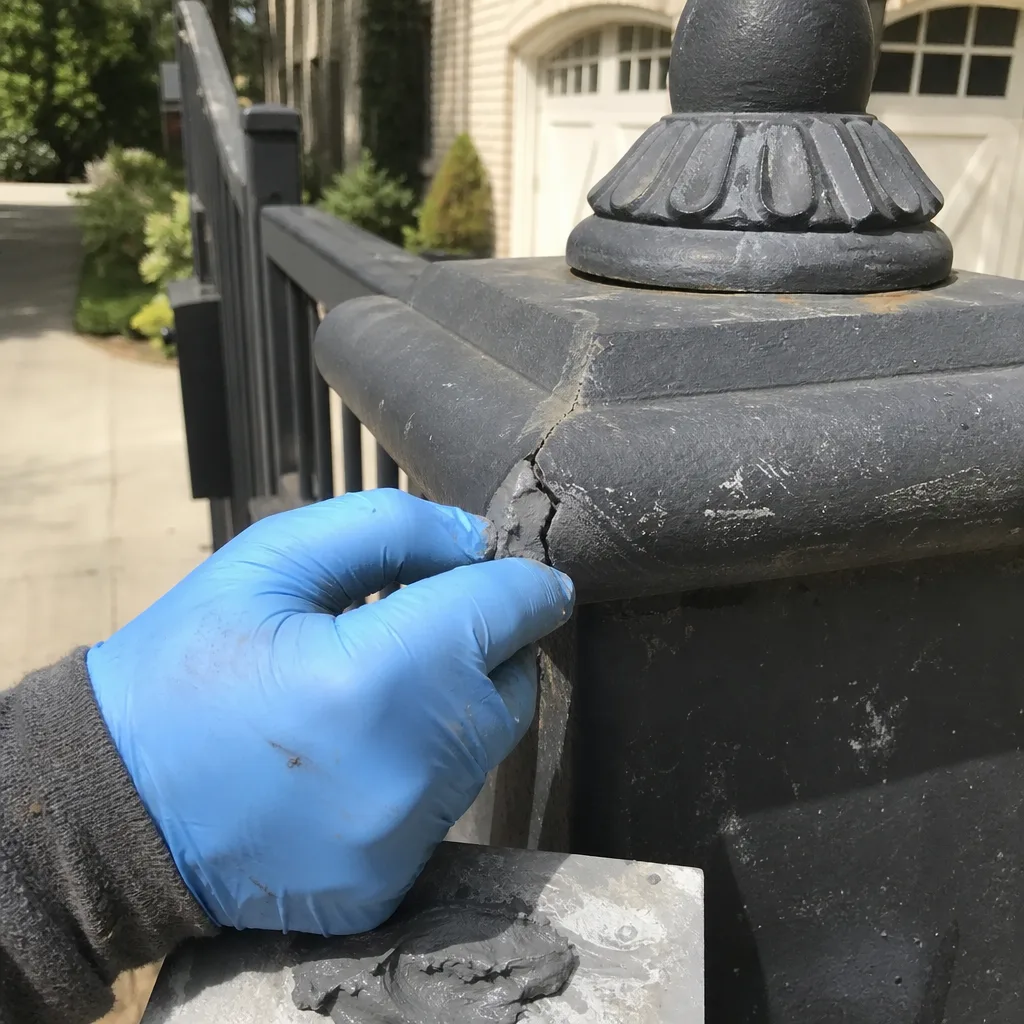
Most modern operators store a rolling log of faults and events. Reading this history before calling anyone gives you diagnostic leverage. Here’s how to access it on common brands we service in Johns Creek.
Step-by-Step: Accessing Fault History
- Locate the display or LED panel. On LiftMaster and Linear operators, this is a small LCD behind the access cover. On Viking and DoorKing, it’s a multi-LED status cluster. On Ghost Controls, a single status LED flashes coded patterns.
- Enter diagnostic mode. LiftMaster: hold the “Learn” button until the display shows “Fd” (fault display). Linear: press and hold “Open” and “Close” simultaneously for 5 seconds. Viking: cycle power, then press “Diagnostic” within 10 seconds. DoorKing: use the 6300 keypad to enter 9-9-9-9. Ghost Controls: count flashes - the pattern repeats every 4 seconds.
- Read the code sequence. Most operators show the most recent fault first. Write down the code and timestamp if shown. Scroll or press to see older entries - we want the pattern, not just the last event.
- Clear history only if instructed. Never clear fault history before a technician arrives. The pattern of old faults is often more informative than the most recent one.
Common Fault Codes and What They Actually Mean
| Code | Brand | Plain-Language Meaning | Likely Failure Chain |
|---|---|---|---|
| Obstruction / Photo Eye | Most brands | The safety circuit opened during travel - could be actual blockage, misaligned photo-eye, or wiring fault | Chain 3 (limit drift causing rebound) or Chain 1 (binding triggering safety) |
| Overload / Thermal | LiftMaster, Linear, Elite | Motor drew excessive current or overheated | Chain 1 (mechanical binding) or Chain 2 (damaged board sending irregular power) |
| Limit Error | Viking, DoorKing | Gate reached expected travel time without hitting limit position | Chain 3 (drift) or Chain 1 (physical obstruction) |
| Low Battery / Power Fault | Ghost Controls, Mighty Mule | Backup battery failed or AC supply dropped below threshold | Chain 2 (board power regulation failing) or separate electrical issue |
| Encoder Fault | FAAC, BFT | Position sensor not returning expected signal | Chain 3 (drift) or Chain 2 (moisture damage to encoder circuit) |
The pattern matters more than any single code. A gate showing “Obstruction” faults at irregular intervals, with no pattern to timing or weather, points to Chain 2 - an intermittent electrical fault. “Overload” faults that increase in frequency through summer suggest Chain 1 - clay expansion binding the gate as soil moisture peaks. “Limit Error” every Tuesday at 6:15 AM is almost certainly Chain 3 - the automatic timer is calling for open, the limit has drifted, and the gate times out.
When you call Gate Repair in Johns Creek, having this history ready lets us bring the right parts and quote accurately. Under the Haven Standard, we document the fault codes we find and photograph the screen before clearing anything.
Adjustment vs. Repair: Why the Difference Matters for Your Invoice
These terms are not interchangeable. Mixing them up is how a $180 service call becomes a $600 surprise.
An adjustment requires no parts replacement. Typical scope: limit-switch recalibration, photo-eye realignment, track cleaning and lubrication, hinge tension adjustment, or control parameter reprogramming. Time on site: 45-90 minutes. Documentation: before/after photos, limit readings, written confirmation of settings changed.
A repair requires parts. Typical scope: control board replacement, motor rebuild or replacement, hinge or wheel replacement, operator arm replacement, track section replacement, or welding repair to gate frame. Time on site: 1.5-4 hours, sometimes with a return visit if parts must be ordered. Documentation: part numbers, serial numbers, wiring diagram of new installation, photo log of work performed.
The confusion happens when an adjustment masks a Gate Repair services need. A technician recalibrates limits on a gate with a bent operator arm. The gate works - for two weeks. Then the arm fails completely. The homeowner pays for the adjustment, then pays again for the repair, and feels deceived even if the technician genuinely missed the bent arm.
Our protocol under the Haven Standard: every adjustment visit includes a 14-point mechanical inspection. We check arm deflection under load, hinge wear patterns, track alignment with a laser level, and motor current draw against manufacturer spec. If we find a condition that will require repair within 12 months, we document it, photograph it, and quote it separately. You choose whether to address it now or monitor it. But you’re not surprised later.
In Johns Creek’s climate, we see this most often with spring hinge adjustments. The hinge can be tensioned to compensate for gate sag - an adjustment - while the root cause is post settlement that will eventually require mechanical repair. We tell you which one we’re doing and why.
Johns Creek Code Requirements That Change Repair Scope
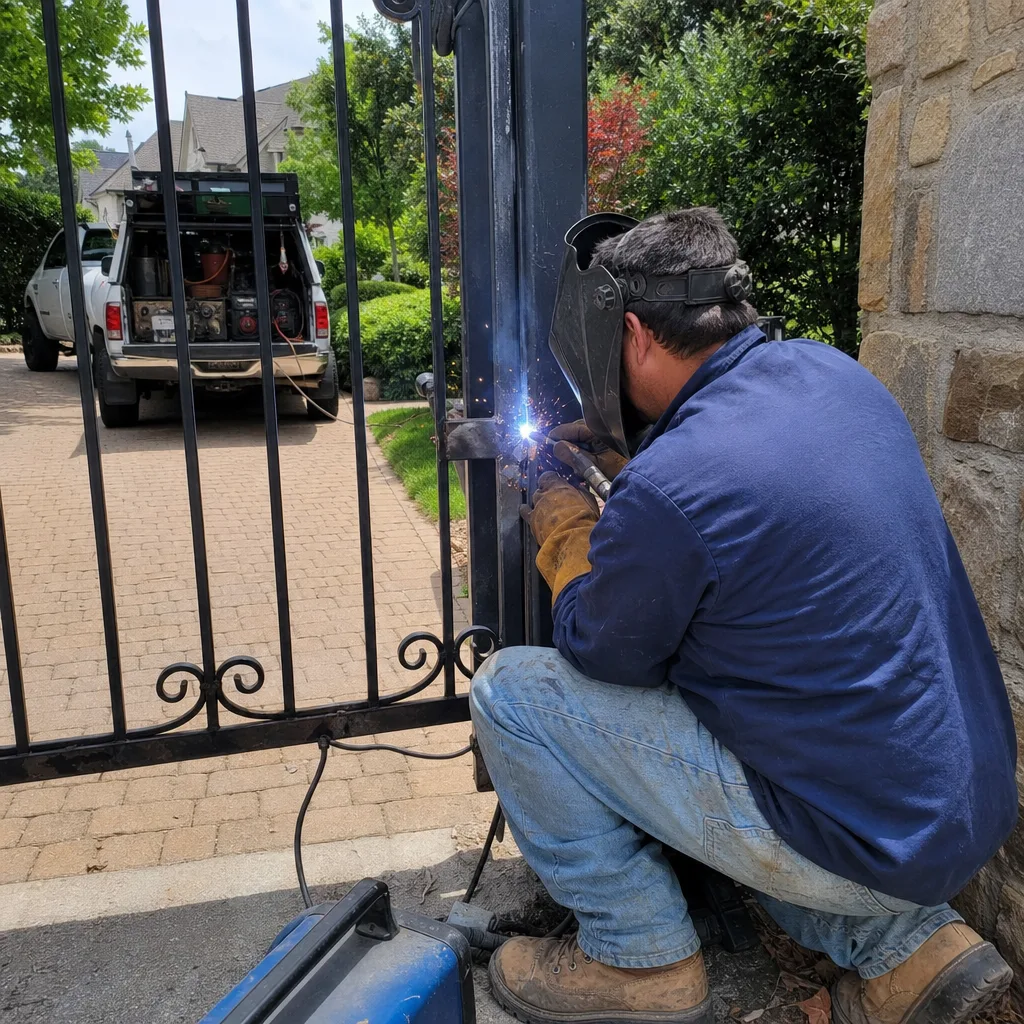
Gate repairs in Johns Creek fall under Fulton County building code, with specific amendments adopted by the city. Two rules regularly surprise homeowners and change repair scope mid-job.
Setback and Sight-Triangle Rules
Residential driveway gates must maintain clear sight triangles at the property line. If a gate panel is damaged and replacement would extend the gate closer to the road than the original installation, the repair may trigger a setback review. We’ve seen this in the Medlock Bridge area where narrow lots place gates close to the right-of-way.
The practical effect: a “simple” panel replacement becomes a permit-required modification if the new panel’s swing arc encroaches on the sight triangle. We check this during our initial site visit and note it in our written scope. If permit work is required, we quote it separately with a clear timeline.
Electrical and Low-Voltage Work
Control board replacement, new photo-eye installation, and access-control wiring all constitute electrical work. In Johns Creek, this must comply with NEC 2020 as adopted by Fulton County, including GFCI protection for outdoor receptacles and proper conduit burial depth (18 inches for residential, 24 inches under driveways).
We frequently find previous repairs where low-voltage wiring was direct-buried without conduit, or where a homeowner-installed Ghost Controls system was powered from an unprotected outdoor receptacle. These are safety issues we document and correct. Under the Haven Standard, we won’t close out a repair with a known code violation in the work area - we quote the correction and explain why.
Permit Triggers for Replacement vs. Repair
Pure repair - replacing a failed component with an equivalent - typically does not require permit. Replacement of the entire operator or modification of the gate structure does. The line blurs when a control board is obsolete and the only replacement requires a new operator chassis. We research this before quoting and handle permit submission when needed.
What a Complete Post-Repair Record Should Contain
Every gate repair company in Johns Creek will hand you an invoice. Almost none hand you a record that protects your next service call. Here’s what the Haven Standard requires on every job, and why its absence costs you money.
The Four Document Types
- Written scope and price. Clause 1: what we agreed to do, for what price, before any work started. Not an estimate - a fixed price. If conditions changed during work, the change order is also written and signed.
- Wiring diagram of the installed or repaired system. For control board replacements, this shows terminal assignments, wire colors, and device addresses. For access-control additions, it shows the full loop. We leave a copy with you and file a copy in our job record.
- Limit-switch or encoder readings. The exact open and close positions recorded after calibration. On a Viking operator, this might read “Open limit: 87 degrees, Close limit: 3 degrees, stall force: 65%.” On a Ghost Controls system, “Open delay: 0 sec, Close delay: 15 sec, auto-close: enabled, force setting: medium-high.”
- Photographic evidence. Minimum eight photos: overall gate condition, operator nameplate, control board before and after, mechanical components showing wear or replacement, wiring termination, safety devices in position, and the completed installation. These are date-stamped and delivered via email or printed.
Why this matters for cost: without a wiring diagram, the next technician spends 30-90 minutes tracing circuits before starting work. That’s billable time. Without limit readings, recalibration starts from scratch instead of from a known baseline. Without photos of component condition, the same worn hinge gets “discovered” again in two years.
We’ve been called to second-opinion jobs in Johns Creek where the previous company left nothing but a credit card receipt. The homeowner paid $840 for a control board replacement with no part number recorded. The board failed in 11 months. No warranty could be enforced - no documentation of what was installed. Under our 365-Day Done Right Promise, the part number in our record is how we honor coverage. No record, no promise.
We offer free second opinions on any written estimate from another company. Bring the paperwork and we’ll review it. If their scope is sound, we’ll say so. If it’s missing critical elements - documentation, code compliance, warranty terms - we’ll point that out in writing.
Brand-Specific Repair Realities: Viking, Ghost Controls, DoorKing, Elite
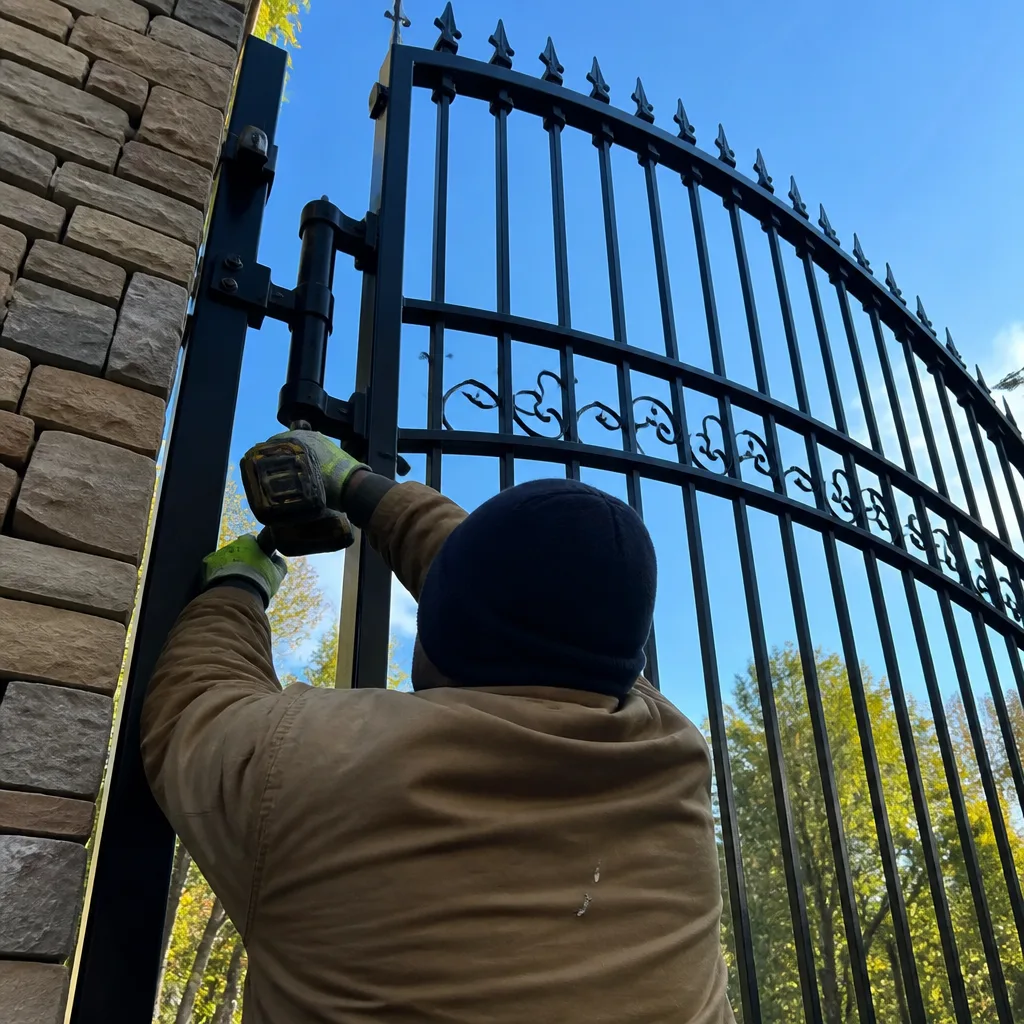
One company that can service whatever motor is already on your property - that’s the practical advantage. Here are repair realities for four common brands in Johns Creek.
Viking
Viking operators are built for commercial duty cycle, which means overbuilt for most residential gates. The failure pattern we see is not wear - it’s environmental. The cast-aluminum housing corrodes at the gasket seam if the cover isn’t seated properly after any service. Water enters, the board fails, and because Viking uses proprietary communication between board and display, generic replacements don’t work. We stock genuine Viking control modules and carry the programming cable to restore factory parameters.
Ghost Controls
Ghost Controls systems are popular for DIY installation in Johns Creek’s newer subdivisions - Abberley Township, Ocee Crossing. The failure pattern is installation-related, not product-related. Battery systems undersized for gate weight and cycle count. Solar panels mounted where afternoon shade from the house drops charging below daily consumption. Control boxes mounted at ground level in irrigation spray zones. We repair these systems regularly, but we also document the installation conditions that will cause repeat failure. For context, see our DIY vs Professional Gate Repair: The Johns Creek Homeowner’s Decision Guide. Under Clause 4, you get photos of the mounting location and a written recommendation if relocation would extend service life.
DoorKing
DoorKing 9100 and 9200 series operators are common in gated communities and estate properties throughout Johns Creek. The telephone entry system integration is where repairs get complex. A gate that won’t open from the keypad may be a gate problem or an entry-system problem. We carry the diagnostic tools to isolate which side of the communication loop has failed, and we document the loop voltage and data packet verification in our repair record.
Elite
Elite operators are straightforward mechanically but use specific limit-switch configurations that confuse technicians trained on other brands. The “slotted optical” limit design requires a specific reset procedure - power down, manually move gate to mid-travel, power up, then teach limits in a specific sequence. Done wrong, the operator runs to mechanical hard stop and damages the gearbox. We’ve repaired Elite gearboxes that failed because a previous technician skipped the mid-travel step. Our documentation includes the limit-teach confirmation code that verifies correct procedure.
Gate Motor & Opener in Johns Creek covers replacement scenarios when repair is no longer economical.
What Gate Repair Costs in Johns Creek
Price visibility is Clause 1 of the Haven Standard. Here are the ranges we quote for common repair scenarios in the Johns Creek market, based on 22,000+ documented jobs since 2014.
| Service Category | Scope | Typical Range |
|---|---|---|
| Adjustment only | Limit recalibration, photo-eye alignment, track cleaning, hinge tension, parameter programming | $180-$260 |
| Mechanical repair | Hinge replacement, wheel/carriage replacement, track section repair, post reset, welding repair | $340-$580 |
| Control board replacement | Board, programming, testing, documentation - motor and gearbox verified healthy | $380-$520 |
| Motor rebuild or replacement | Operator-specific motor/gearbox assembly, limit teach, force calibration | $620-$1,180 |
| Operator arm replacement | Linear actuator or articulated arm, bracket alignment, force calibration | $440-$720 |
| Full operator replacement | New unit, removal, installation, wiring, limits, safety devices, documentation | $1,380-$2,400 |
| Access-control repair | Keypad, card reader, loop detector, telephone entry - diagnosis and component replacement | $280-$740 |
These are quoted prices, not estimates. The price we write is the price you pay. If we discover additional needed work during the job, we stop, explain, and get written authorization before continuing. No invoice exceeds the written scope without your signature.
Several Johns Creek-specific factors affect where a job falls in these ranges:
- Gate material and weight - wrought iron gates in Country Club of the South require heavier hardware than aluminum gates in Rivermont
- Operator age and parts availability - some pre-2015 Elite and Mighty Mule boards are obsolete, requiring creative sourcing or full replacement
- Electrical condition - unpermitted previous work, direct-buried cable, or missing GFCI protection adds code-correction scope
- Access difficulty - steep grades, limited equipment access, or landscaping that must be protected
For Gate Installation in Johns Creek, we provide free measurement and written pricing - that work is scheduled, not dispatched for same-day completion.
Preventive Maintenance for Johns Creek’s Climate
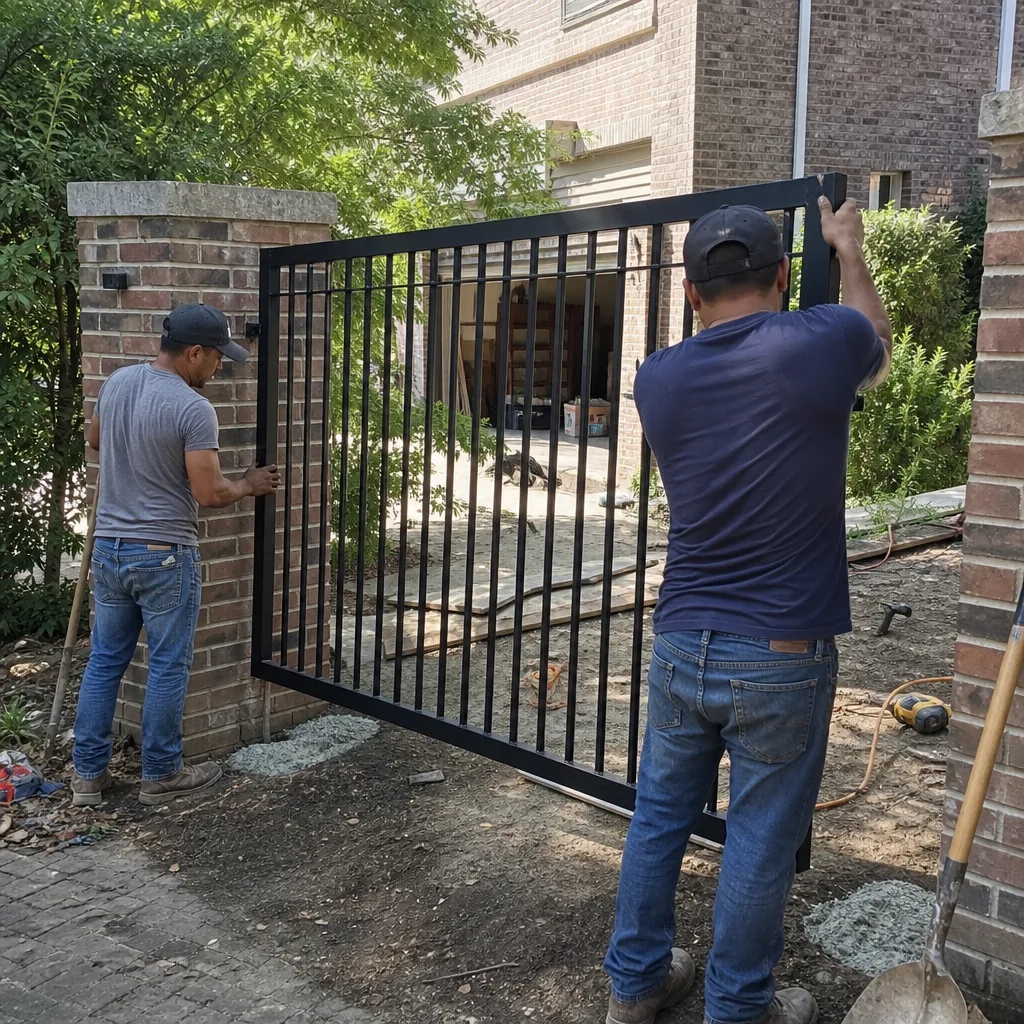
For more guides & resources, explore our blog. The failure chains described above are not inevitable. They’re accelerated by specific conditions that maintenance addresses.
Spring: Post-Settlement Check
After the last frost, check gate operation during the wettest part of spring. Clay is fully expanded. If the gate drags now, the post has shifted over winter. Addressing it before summer drought locks the soil prevents the accelerated hinge wear that follows.
Summer: Control Box Inspection
Open the operator housing after the hottest, most humid week. Look for condensation on the inside of the cover, corrosion on terminal screws, or a musty smell. These are early Chain 2 indicators. We offer a seasonal inspection service that includes desiccant pack replacement and terminal treatment with corrosion inhibitor.
Fall: Limit Verification
Run the gate through five complete cycles and time each. Variation over 10% from cycle to cycle suggests limit drift or developing mechanical binding. Note any reversal at the same point - that’s Chain 3 developing. Caught here, it’s an adjustment. Ignored until winter, it often becomes a motor repair.
Winter: Mechanical Lubrication
Hinges, rollers, and track need lubrication before the cold-dry cycle begins. We use lithium-based grease for metal-to-metal contact and silicone spray for plastic rollers. WD-40 is not lubrication - it’s a solvent that strips existing protection.
Common Mistakes to Avoid
- Calling for “same-day” on a non-urgent issue. Speed language belongs on actual emergencies - a gate stuck open with pets or children unsecured. For intermittent operation or gradual decline, a scheduled diagnostic produces better documentation and often lower cost than a rushed dispatch.
- Accepting a verbal estimate. If the price isn’t written before work starts, you have no enforceable scope. The Haven Standard exists because we’ve seen too many Johns Creek homeowners show us invoices 40% above the “estimate” they were given over the phone.
- Clearing fault codes before documenting them. The pattern of historical faults often reveals the true failure chain. A technician who clears codes and starts fresh loses diagnostic information that could prevent repeat failure.
- Ignoring gradual changes. A gate that takes 14 seconds to open instead of 12 is not “still working.” It’s a motor working 17% harder, drawing more current, heating more, and failing sooner. Document the baseline and track drift.
- DIY control board replacement without parameter backup. Modern operators store force limits, speed curves, and accessory addresses in volatile memory. Disconnect power without recording settings, and the new board has no reference for correct configuration. We back up all parameters before any electrical work.
- Assuming all technicians know all brands. A technician trained primarily on LiftMaster may misdiagnose a Viking encoder fault or an Elite limit procedure. Ask specifically about brand experience, or choose a company that documents training across multiple manufacturers.
- Neglecting the photo record. If your repair company doesn’t document what they found and what they changed, the next company - maybe us, maybe someone else - starts from zero. That costs you diagnostic time on every future call.
When to Call a Professional
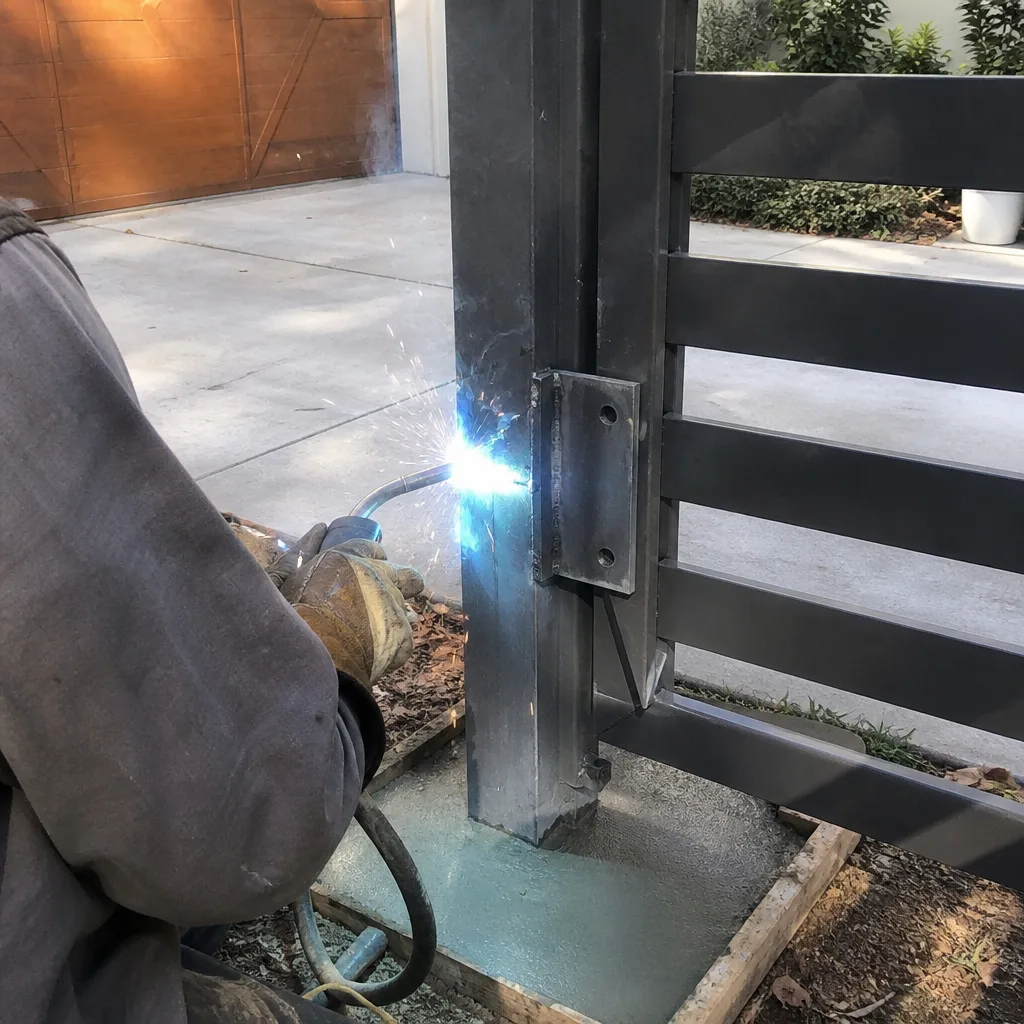
Call when the failure chain is unclear, when fault codes indicate electrical or motor involvement, or when any safety device is implicated. A gate that reverses without visible obstruction may have a failed edge sensor - and a failed safety device is a liability issue, not just a convenience issue.
Call when the repair requires parts you don’t have on hand, or when the operator is under manufacturer warranty that DIY work might void. Call when the gate is stuck open and security is compromised, or stuck closed and vehicle access is blocked.
Vance Gate Repair Johns Creek offers free estimates in Johns Creek - call (678) 394-1765. A live person answers 24 hours a day, seven days a week. We’ll ask about symptoms, fault codes if you’ve read them, and brand if you know it. For urgent issues, we dispatch background-checked, uniformed technicians with name and photo provided before arrival. For non-urgent diagnostics, we schedule at your convenience and arrive with the Haven Standard: written price before work, documented record after.
Frequently Asked Questions
Most residential gate repairs in Johns Creek range from $180 for adjustment-only service to $650 for part replacement including control boards or mechanical components. Full operator replacement runs $1,380-$2,400 depending on brand and gate configuration. Call (678) 394-1765 for an exact quote - estimates are free and the written price is fixed before any work starts.
We repair motors when the failure is isolated to a replaceable component - control board, capacitor, gear set, or wiring. Replacement becomes the better option when the motor is over 10 years old, the manufacturer has discontinued parts, or multiple failures indicate systemic wear. We document the motor condition with current-draw readings and give you both options in writing.
The most common cause in Johns Creek is limit-switch drift - the operator thinks the gate hasn’t reached its endpoint, keeps driving, and the safety system reverses it when rebound is detected. Less commonly, a misaligned photo-eye or failing edge sensor sends a false obstruction signal. We distinguish these causes by checking fault-code history and testing each safety device independently.
We handle permit applications when the repair scope triggers Fulton County requirements - typically full operator replacement or structural modifications that affect setback compliance. Pure component replacement on existing gates usually does not require permit. We research this during our initial site visit and include permit handling in our written scope when needed.
If any repair we complete is not right - same fault returns, related component fails due to our oversight, or the gate doesn’t perform as documented - we return and make it right at no additional charge within one full year. No argument, no fee, no expiration date within that window. The promise is enforceable because every job has a documented record of what was installed and how it was configured.
For security-compromised gates in Johns Creek, we dispatch as available same-day. A live person answers (678) 394-1765 at any hour - no voicemail, no callback queue. For non-urgent issues, we schedule within 24-48 hours and arrive with parts for common failures already on the truck.
The Bottom Line
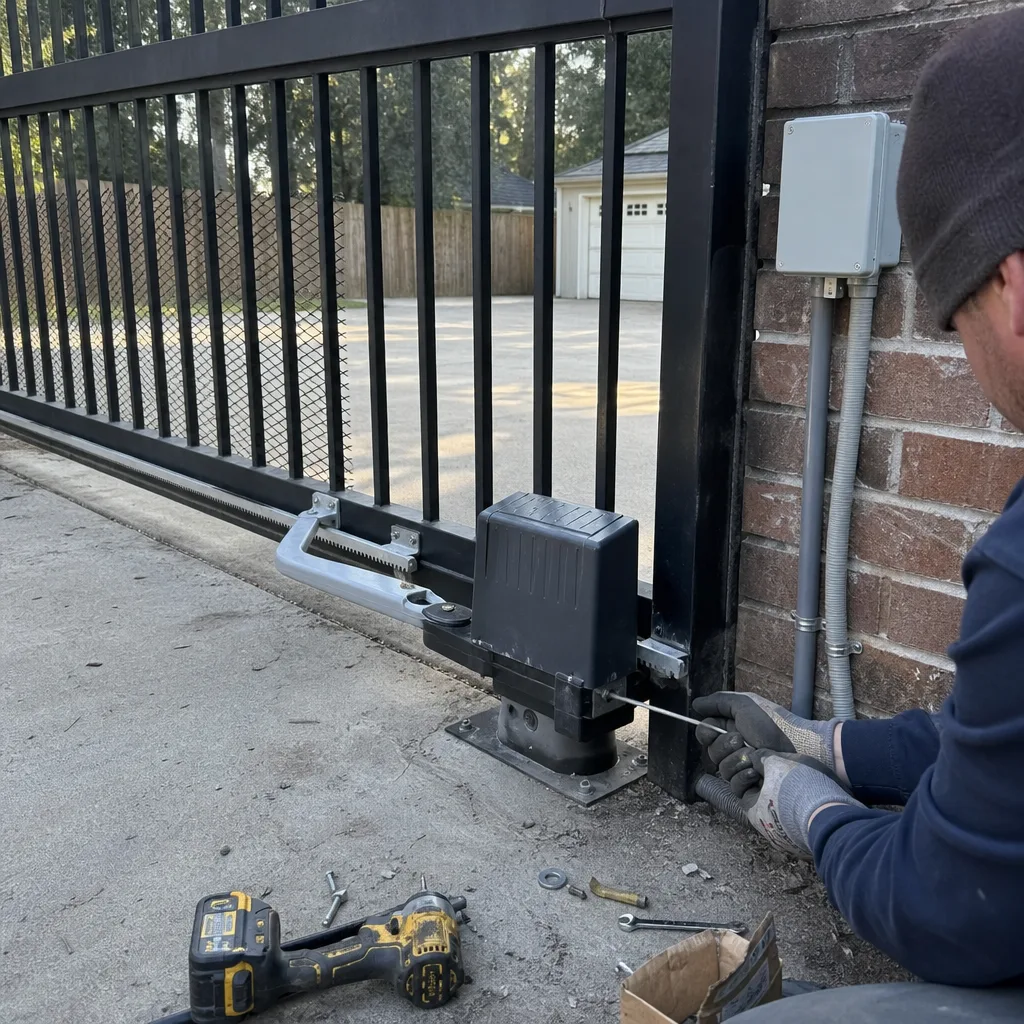
Gate repair in Johns Creek is not about chasing symptoms. It’s about identifying which of three failure chains - mechanical wear from clay-soil settling, moisture damage to control electronics, or limit-switch drift - is actually driving the behavior you see. Read your fault codes before calling anyone. Know the difference between an adjustment and a repair, and insist on written scope for either. Demand a documented record that includes wiring diagrams, limit readings, and photographs - its absence will cost you on every future service call. And understand that local code requirements around setbacks and electrical work can change repair scope in ways that should be identified before work starts, not discovered mid-job.
We’ve applied these principles across 22,000+ gates since 2014, every one with a written price before the first tool came out and a documented record when we left. The Haven Standard isn’t marketing language - it’s the documentation habit Adrian Vance developed on commercial access-control sites, applied to every residential driveway gate we touch in Johns Creek.
Call (678) 394-1765 for a free estimate. A live person will answer, ask the right questions about what you’re seeing, and schedule a technician who arrives with name, photo, and the tools to fix it right the first time.
Written by Adrian Vance, Owner at Vance Gate Repair Johns Creek, serving Johns Creek since 2014.